
How to Write Research Questions That Actually Get Answered
You've chosen a topic, opened several articles, and still can't write the sentence your supervisor is waiting for. “Social media and mental health” feels important, but it isn't yet a research question. It's a field of interest with too many populations, platforms, outcomes, settings, and possible explanations packed inside it.
Learning how to write research questions means learning to make decisions. You'll move from curiosity to scope, from scope to an evidence gap, and from that gap to a question your study can answer. The strongest question isn't the most dramatic one. It's the one whose terms, boundaries, evidence, and method you can defend.
Table of Contents
- Why Most Research Questions Fail Before They Start
- Narrowing a Broad Topic into a Real Question
- The FINER and PICO Lenses for Testability
- Rewriting the Same Question Across Research Approaches
- Turning a Literature Gap Into a Question You Can Defend
- Two Real Before and After Rewrites
- Self Audit Checklist and Common Pitfalls
Why Most Research Questions Fail Before They Start
A weak research question usually fails before the writer searches for another source. The wording reveals that the project has not yet decided what will be studied, for whom, under which conditions, or with what evidence.
The first failure is excessive breadth. “How does technology change education?” could lead toward classroom practice, assessment, teacher workload, access, learning outcomes, or institutional policy. A project that tries to cover all of those will collect information without producing a coherent answer.
The second is vagueness. Words such as impact, wellbeing, success, and society may sound academic, but they don't tell the reader what you'll observe or analyze. A question becomes testable only when its important terms can be connected to evidence.
A third problem is borrowed framing. Students often copy the language of a published paper, including its assumptions, population, and definition of the problem. Literature should inform your question, not write it for you. Your study may address a limitation in that paper, but it must establish its own scope.
The fourth failure is hidden bundling. “How does social media affect teenagers' sleep, anxiety, friendships, school performance, and identity?” is several projects disguised as one sentence.
Practical rule: If one answer would need several unrelated methods or separate conclusions, the draft probably contains more than one question.
A useful response to ambiguity is to name what you know, what you don't know, and what evidence could resolve the uncertainty. The guidance on handling ambiguity in research offers a practical way to make that uncertainty visible instead of hiding it inside broad wording.
University guidance from George Mason University on writing a research question describes a refinement process that begins with a general topic, uses preliminary reading, narrows the focus, and evaluates the final question for clarity and feasibility. That gives you a four-part journey: define the territory, constrain the study, locate the evidence weakness, and audit the final wording.
Narrowing a Broad Topic into a Real Question
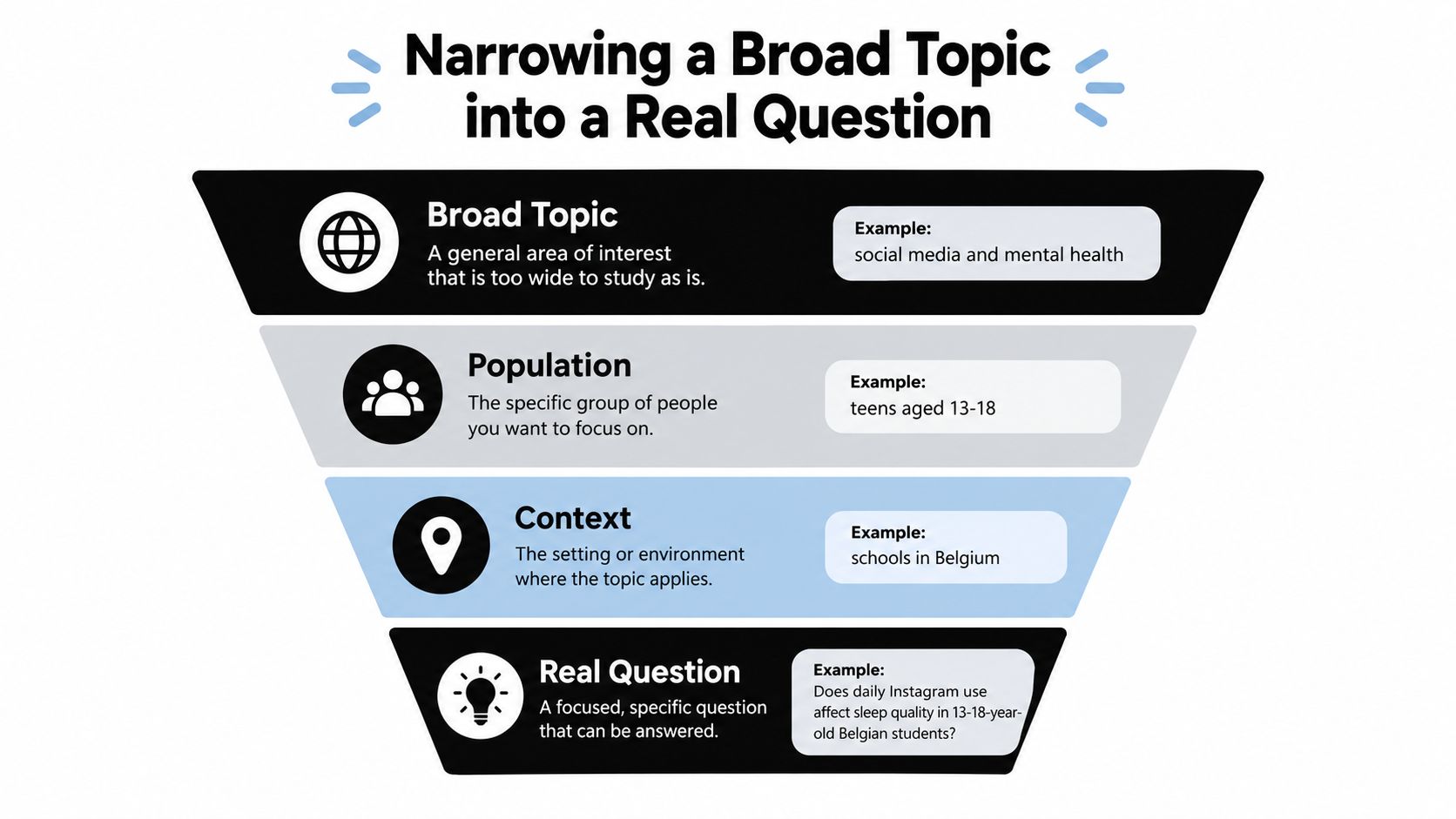
Start with a topic that interests you, but don't mistake interest for scope. “Social media and mental health” is useful as a search area because it gives you vocabulary for preliminary reading. It isn't suitable as a final question because it leaves almost every research decision open.
Narrow the topic by applying checkpoints. Each checkpoint removes plausible alternatives and makes the remaining inquiry easier to investigate.
Use constraints that change the answer
Begin with who. “Teenagers” may still cover different ages, educational stages, and circumstances, so a draft might focus on teens aged 13 to 17. Then ask what context matters. General social media use is different from Instagram use, passive scrolling, posting, messaging, or school-related activity.
Next, define what outcome you can examine. Mental health is a broad domain. Sleep quality, perceived stress, depressive symptoms, or social connectedness are more specific possibilities, though each requires an appropriate definition and measure. Add when and where if those boundaries affect access or interpretation, such as use over six months among students in urban high schools.
The result could become:
How is daily Instagram use associated with sleep quality among students aged 13 to 17 in urban high schools over six months?
This wording is sharper because it identifies a population, an activity, an outcome, a setting, and a period. It also uses associated with rather than automatically claiming that Instagram use causes a change. If your design can't establish causation, your language shouldn't imply that it can.
Use this checkpoint list on your own draft:
- Who: Which people, documents, organizations, or communities are included?
- What: What phenomenon, intervention, variable, text, or experience will you examine?
- Where: Which institution, region, platform, archive, or social setting defines the context?
- When: What period makes the question manageable and meaningful?
- What would change my mind: Which finding, interpretation, or contradiction would challenge your initial expectation?
The stepwise research-question guidance in a published medical research article similarly emphasizes moving from a broad subject through literature review toward a defined population, exposure or intervention, and outcome. The point isn't to force every discipline into a medical template. It's to make your nouns and relationships concrete enough that another researcher can see what an answer would involve.
The FINER and PICO Lenses for Testability
A draft question can be narrow and still be unusable. FINER and PICO help you inspect different weaknesses rather than treating one framework as a magic formula.
FINER asks whether a project is Feasible, Interesting, Novel, Ethical, and Relevant. PICO asks you to identify the Population, Intervention, Comparator, and Outcome, especially when the study evaluates an intervention or relationship.
Consider this sample public health question:
Among adults receiving tuberculosis treatment in rural clinics, do text-message reminders improve treatment adherence compared with usual care?
This is a hypothetical example for examining question design. Its PICO elements are visible: the population is adults receiving treatment in rural clinics; the intervention is text-message reminders; the comparator is usual care; and the outcome is treatment adherence.
The FINER lens adds a different set of tests. Feasibility depends on access to clinics, participants, reliable adherence information, and an appropriate study period. The question is interesting if adherence barriers matter to the people conducting and using the research. Novelty doesn't require claiming that nobody has ever studied reminders. It may come from examining a particular rural context or addressing a weakness in existing evidence. Ethical review would need to cover consent, privacy, communication practices, and the consequences of participation. Relevance asks whether the answer could inform treatment support or future research.
| Evaluation Lens | Component | Applied to the Sample Question |
|---|---|---|
| FINER | Feasible | Can the researcher access rural clinics, participants, and trustworthy adherence evidence? |
| FINER | Interesting | Does the problem matter to patients, clinicians, or health-service researchers? |
| FINER | Novel | Does the study address an unresolved limitation, context, population, or comparison? |
| FINER | Ethical | Can reminders and data collection occur with informed consent and appropriate privacy? |
| FINER | Relevant | Could the findings inform treatment support or service decisions? |
| PICO | Population | Adults receiving tuberculosis treatment in rural clinics |
| PICO | Intervention | Text-message reminders |
| PICO | Comparator | Usual care |
| PICO | Outcome | Treatment adherence |
The University of Michigan research-question guide stresses that a question should be answerable with accessible facts and data, while also connecting question design to literature review and the FINER framework. The Harvard Medical School guidance on effective research questions and study methods also recommends structured framing for quantitative work and warns against allowing a central question to expand into an unwieldy collection of subquestions.
A question may pass one lens and fail another. A fascinating question can be impossible to access. A feasible question can be ethically problematic. A novel question can still lack a meaningful outcome. Use both lenses before you commit to a method.
Rewriting the Same Question Across Research Approaches
Your research approach changes the shape of the question. A quantitative study asks you to define variables and examine relationships or differences. A qualitative study asks you to understand meaning, experience, or process within a bounded group and setting. A mixed-methods study must explain how the two kinds of evidence will complement each other.
Take one shared interest: sleep quality among night-shift hospital nurses. The topic stays stable, but the question must match the evidence you intend to collect.
| Approach | Research Question | Structural Constraint |
|---|---|---|
| Quantitative | What is the association between night-shift frequency and measured sleep quality among hospital nurses in one regional hospital? | Define the variables, population, setting, measurement instruments, and analysis clearly enough for statistical testing. |
| Qualitative | How do night-shift hospital nurses describe the effects of irregular schedules on their sleep and recovery? | Bound the participants and phenomenon, then focus on lived experience rather than a numerical effect. |
| Mixed methods | What is the relationship between night-shift frequency and sleep quality among hospital nurses, and how do nurses explain the scheduling experiences behind that relationship? | State how the measurable pattern and participant accounts will be integrated. |
The quantitative version foregrounds relationship, frequency, and measurement. It shouldn't promise a causal effect unless the design supports that claim. The qualitative version uses describe because the researcher wants depth, interpretation, and the participants' understanding of recovery. The mixed-methods version adds an integration question. It doesn't merely place a survey and interviews beside each other.
Match wording to evidence
For a quantitative question, decide which variables you'll measure and whether the design examines description, comparison, association, or cause. For a qualitative question, define who can speak meaningfully about the phenomenon and what experience or process you want to understand. For mixed methods, identify the point of connection. Will interviews explain an unexpected survey pattern, or will qualitative findings help interpret a measured outcome?
A useful research prompt collection can help you generate alternative formulations, but generated wording still needs human judgment. Check every term against your proposed participants, instruments, sources, ethics requirements, and available time.
A method doesn't rescue a mismatched question. Choose the question you can answer with the evidence you can responsibly obtain.
Turning a Literature Gap Into a Question You Can Defend
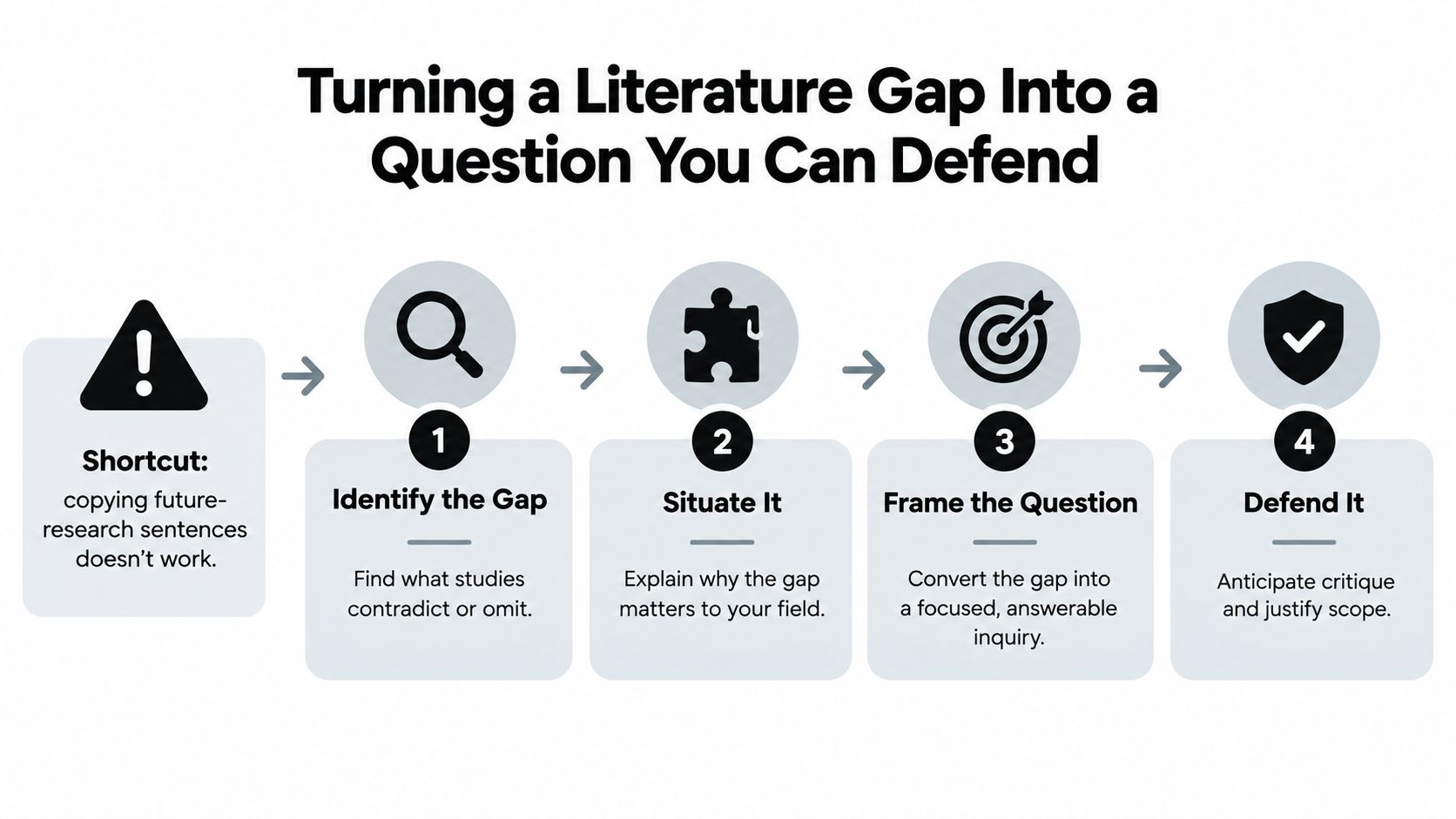
A literature gap becomes useful only when it can guide a study you can complete. A field may already contain many papers on your topic while leaving a contradiction, neglected population, outdated context, weak evidence base, imprecise concept, or unresolved limitation. Your task is to turn that unfinished point into a question with clear boundaries, suitable evidence, and a defensible claim.
A sentence such as “future research should examine...” is a signpost, not a finished question. Treat it as a proposal from another study, then inspect what that study could not establish. Decide whether your participants, setting, method, and available evidence can address that limitation without claiming to solve the entire problem.
Read limitations as evidence about the next question
Suppose a qualitative study examines adolescent diabetes self-management but excludes rural boys. The gap is more precise than “rural boys have not been studied.” Existing findings may not explain how location and gendered experience shape daily self-management for this population.
Move from limitation to question through four decisions:
- Identify the gap. Record the omitted group, contradiction, limitation, or context. Avoid the empty phrase “more research is needed.”
- Situate the gap. Explain why the omission matters to the concept under study. Rural participants may encounter different access conditions, routines, support systems, or social expectations.
- Frame the question. Set a feasible region, age range, phenomenon, and method. For example: How do rural boys aged 14 to 18 in [region] experience barriers to daily insulin self-management?
- Defend the scope. Show that the participants, setting, recruitment route, and evidence fit the question. The study should not claim to explain every adolescent's experience.
A practical literature workflow is to scan recent studies, inspect their discussion and limitation sections, and write a tight gap sentence before drafting the question. This guide to AI for academic research can support that review process, while the CASRAI guide to writing a research question directs attention toward contradictions, bias, missing populations, imprecision, and insufficient evidence. Use these resources to organize reading, not to substitute generated wording for your own judgment.
This short video can provide another visual explanation of the research process:
Choose verbs that match what your evidence can support. Explore, describe, compare, and examine usually make a narrower claim than prove, establish once and for all, or fill the void. For support in shaping a defensible project proposal, consult this guide on how to write a grant, particularly when connecting a research problem to a feasible design and public value.
Two Real Before and After Rewrites
A good rewrite doesn't decorate a weak question with academic vocabulary. It removes ambiguity one decision at a time.
Technology and society
Before: How does social media affect mental health?
This version leaves the population, platform, activity, outcome, design, and timeframe unresolved. “Mental health” could refer to several constructs, while “affect” suggests causation that the researcher may not be able to test.
The editing sequence might look like this:
- Population: adolescents in secondary education.
- Platform: Instagram, rather than social media as a whole.
- Activity: daily use, rather than every possible form of engagement.
- Outcome: sleep quality, rather than mental health in general.
- Timeframe: a defined observation period.
- Relationship language: “associated with” unless the design supports a causal claim.
After: How is daily Instagram use associated with sleep quality among secondary-school students in urban high schools over a defined study period?
The final version cuts platforms, age groups, outcomes, and settings that the study won't examine. It could survive committee review because a reader can identify the proposed population, exposure, outcome, and context without guessing what the researcher means.
Historical memory
Before: How has historical memory changed over time?
This question has no country, period, source base, or analytic angle. It could become a study of museums, schoolbooks, memorials, oral histories, political speeches, or public ceremonies across many places and decades.
A focused humanities rewrite could make four choices:
- Country: Belgium.
- Period: the postwar period, with a clearly defined archival boundary in the proposal.
- Source type: school history textbooks.
- Analytic angle: how the texts represent civilian responsibility during wartime occupation.
After: How did Belgian secondary-school history textbooks represent civilian responsibility during wartime occupation in the postwar period?
This question doesn't claim to measure what all Belgians remembered. It defines a source type and asks an interpretive question that textual analysis can address. Its defensibility comes from the relationship between the claim and the evidence, not from a grand promise about national memory.
The best revision often makes the project smaller while making its contribution easier to recognize.
Try the same process on your draft. Circle every word that could mean several things, underline every unstated boundary, and replace the broadest term with the population, source, setting, or phenomenon you can investigate.
Self Audit Checklist and Common Pitfalls
Run this audit before you finalize a proposal, submit a research plan, or build a literature search. Answer each prompt with yes or no, and treat every “no” as an editing instruction rather than a personal failure.
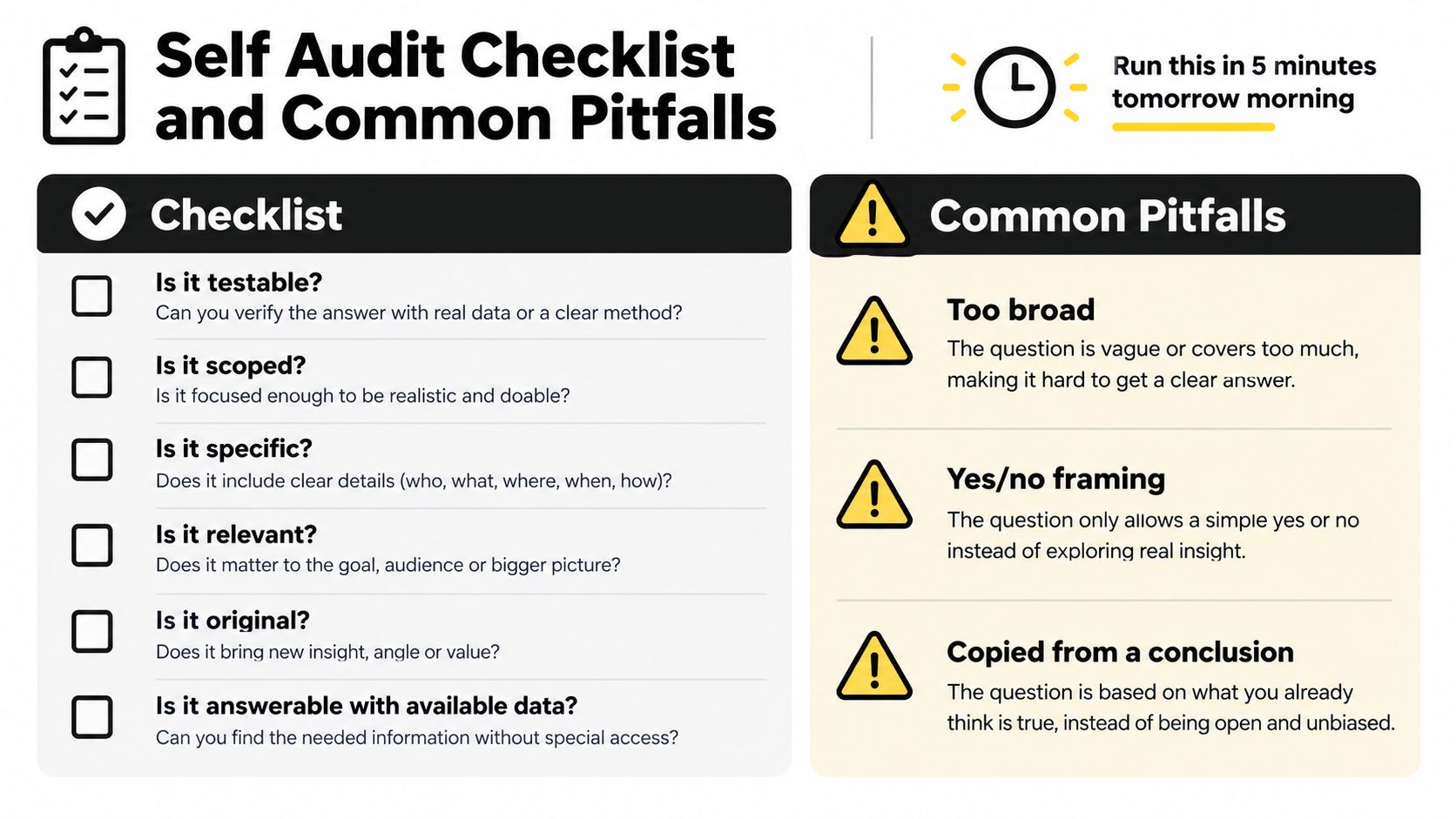
- Is it testable? Can you identify the evidence, observations, texts, participants, or comparisons that could answer it?
- Is it scoped? Does the question define a manageable population, setting, period, source base, or phenomenon?
- Is it specific? Would two readers interpret the key terms in roughly the same way?
- Is it original but defensible? Does it address an unresolved limitation without claiming that the entire field has been overlooked?
- Is it ethically clear? Can you explain how participants, sensitive information, consent, privacy, or vulnerable groups will be handled?
- Is it answerable with available data and access? Can you reach the relevant people or sources within your permitted time and resources?
Pitfalls that look acceptable at first
The topic shaped as a question only adds a question mark to a subject. “What about artificial intelligence in education?” still doesn't identify what will be examined.
The bundled question asks about several outcomes or populations at once. If the answer requires separate studies, remove the least important strand or make it a subquestion that supports the central inquiry.
The crystal-ball question asks what will happen across an indefinite future. Replace prediction with an observable period, documented process, or clearly bounded scenario.
The causation shortcut confuses description or association with cause. A survey can reveal patterns, but the wording must match what the design can support.
When a question fails, you have three recovery moves. Cut the least relevant element. Merge overlapping ideas into one outcome or phenomenon. Re-aim the project at a narrower population, setting, source type, or period. A smaller question with accessible evidence is stronger than an ambitious question that cannot be answered responsibly.
Use the audit again after your preliminary reading, because new evidence may expose a contradiction, missing population, or feasibility problem that changes the best wording.
Prompt Builder provides research-focused prompts for formulating and refining questions, including clearer scope, measurable terms, and testable hypotheses. Visit Prompt Builder to turn your draft into structured alternatives, compare formulations, and refine the version you can defend with your available evidence.
Related Posts
AI for Academic Research: A 2026 Practical Guide
May 28, 2026