
SEO Content Brief Example: The Complete Template
A writer opens a Slack message and finds three bullets: “Write about SEO content briefs. Include keywords. Send it by Friday.” The deadline is real, but the assignment still leaves almost every important decision unresolved. Which reader is the article for? What does that reader want from the search? How much depth is appropriate? Which questions must the draft answer, and what should the reader do next?
A complete SEO content brief removes that uncertainty before drafting begins. It gives the writer a practical specification for the page, while giving the strategist, editor, and stakeholder a shared record of what success means. The strongest briefs have evolved from loose topic notes into structured, page-level writing specifications that cover keywords, intent, audience, outline, links, metadata, and calls to action, as shown in these SEO content brief examples.
Table of Contents
- What a Complete SEO Content Brief Actually Looks Like
- The Strategic Fields Every Brief Has to Define First
- SEO Content Brief Example for a Filled-In Article Brief
- Turning the Top SERP Results Into a Brief Outline
- On-Page Specifications Writers Can Measure Against
- The Reusable SEO Content Brief Template
- The AI-Search Fields Most Briefs Still Leave Out
- FAQ Strategy in a Brief That Actually Earns Its Place
- The Editor's Checklist for Grading a Draft Against the Brief
- Quick-Reference Brief Card to Pin Next to the Writer
What a Complete SEO Content Brief Actually Looks Like
A real brief is a contract between strategist and writer, not a suggestion box. It defines the decisions already made and identifies the decisions the writer still owns. That distinction matters because every missing instruction becomes a guess, and guesses create rewrites, inconsistent drafts, and wasted research time.
A complete document contains eight functional blocks:
- Strategic context: The business objective, page role, funnel stage, and success condition.
- Keyword and intent package: The primary keyword, related terms, search intent, ranking context, and questions to answer.
- Audience and angle: The intended reader, their knowledge level, their problem, and the distinctive editorial position.
- SERP-derived outline: Required headings based on recurring ranking-page themes, plus sections competitors fail to cover.
- On-page specifications: Word-count range, title, H1, meta description, voice, heading rules, and visual requirements.
- Linking plan: Internal destinations, suggested anchors, external evidence, and source-quality expectations.
- Supporting assets: Tables, screenshots, diagrams, videos, downloadable resources, or schema notes.
- Acceptance criteria: The checks an editor will use before approving publication.
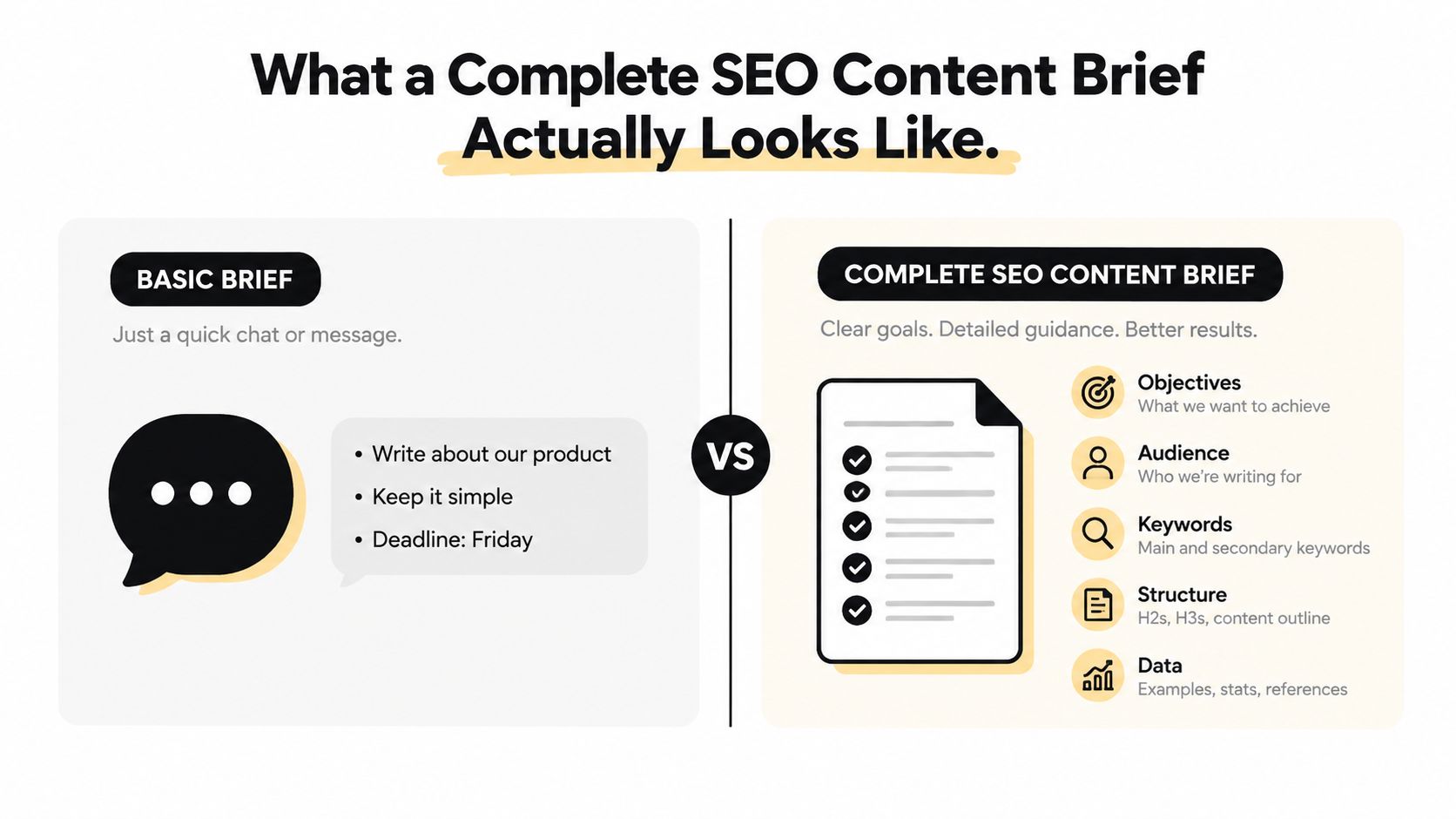
Practical rule: If the writer has to ask what the page is trying to achieve, who it serves, or what it must contain, the brief isn't finished.
Structure still shouldn't become a cage. A writer needs room to develop examples, transitions, and a credible point of view. A useful simple structure formula from Narrareach can help teams preserve a readable flow while the brief handles the SEO and operational constraints.
The rest of the document should answer one question: what does each field change in the final draft? If removing a field wouldn't alter the writer's decisions, it probably doesn't belong in the brief.
The Strategic Fields Every Brief Has to Define First
The upstream fields determine nearly everything downstream. A vague objective produces a vague angle, which produces a generic outline, regardless of how many keywords appear in the document.
Start with the objective. “Drive traffic” isn't an operating instruction. A useful objective might be to compete for informational searches currently ranking in the middle of the results, or to support a commercial path for readers evaluating a template. The objective tells the writer whether to prioritize breadth, explanation, comparison, proof, or conversion.
The primary keyword identifies the page's central search topic. Search intent then turns that topic into a page type. Informational intent usually calls for explanation or instruction. Commercial investigation often requires comparisons, selection criteria, and practical evaluation. Transactional intent generally demands a product, service, or conversion-focused page. Treating every keyword as a blog-post opportunity is one of the fastest ways to create a page that answers the wrong question.
Secondary keywords should appear in the brief, grouped by subtopic rather than dumped into a list. That grouping helps the writer use related terms in meaningful headings and explanations instead of sprinkling phrases into existing prose. Brief guidance commonly pairs keyword targets with search volume, keyword difficulty, and ranking status, making the planning decision more explicit, as described in this SEO content brief template guidance.
Strategic fields and what they constrain
| Brief Field | What It Locks Down | Failure When Missing |
|---|---|---|
| Objective | Business outcome and page role | The article earns attention without serving a defined purpose |
| Primary keyword | Central topic and page focus | The draft drifts across related subjects |
| Search intent | Format, depth, and reader expectation | A how-to becomes a sales pitch, or a product page becomes a generic article |
| Secondary keywords | Subtopics and heading opportunities | Related language gets forced into body copy |
| Audience snapshot | Knowledge level, pain points, and examples | The writer chooses the wrong assumptions and vocabulary |
| Unique angle | Distinctive editorial position | Multiple articles become interchangeable |
The audience snapshot should name the reader's role, current problem, and likely next decision. “Marketing professionals” isn't enough. “An in-house content lead who needs a brief a freelance writer can execute without repeated Slack questions” gives the writer something operational.
Finally, define the angle. It prevents two writers from producing structurally identical articles for the same topic. “A complete guide” is not an angle. “A field-by-field working document that explains what each instruction changes in the draft” is. Competitors can cover the same subject, but your page still needs a reason to exist.
SEO Content Brief Example for a Filled-In Article Brief
A practical strategic block for this article could look like this:
| Field | Filled-in value | What the value changes |
|---|---|---|
| Objective | Rank in the top five for the target query and earn relevant editorial links from content operations newsletters | The draft needs strong practical depth, a reusable asset, and a clear point of view |
| Primary keyword | SEO content brief example | The phrase defines the page topic and must appear naturally in prominent page elements |
| Intent | Informational, with a commercial-investigation undertone | Readers want to learn, but many are also looking for a template they can adopt |
| Secondary keywords | Content brief template, SEO writing guide, brief checklist | These become supporting topics and possible heading language |
| Audience | In-house content leads and freelance writers | Examples should address handoffs, approvals, revisions, and execution |
| Unique angle | A working document that explains each field, demonstrates a filled-in brief, and addresses AI-search and FAQ gaps | The article must show decisions, not merely define terminology |
The primary keyword sits in a phrase-match slot, but that doesn't mean the writer should repeat it mechanically. The phrase establishes the page's subject. Natural variations can handle the surrounding language, provided they support the same intent.
The intent label also rules out certain formats. This isn't a product landing page, a keyword glossary, or a short checklist with no explanation. It needs to teach the reader how to build and use a brief, then provide a document that can be adapted.
The objective adds a business boundary. A page designed to attract content operations readers should demonstrate operational judgment, not just repeat common SEO advice. That means explaining trade-offs, showing what belongs in each field, and making the resource useful enough to reference.
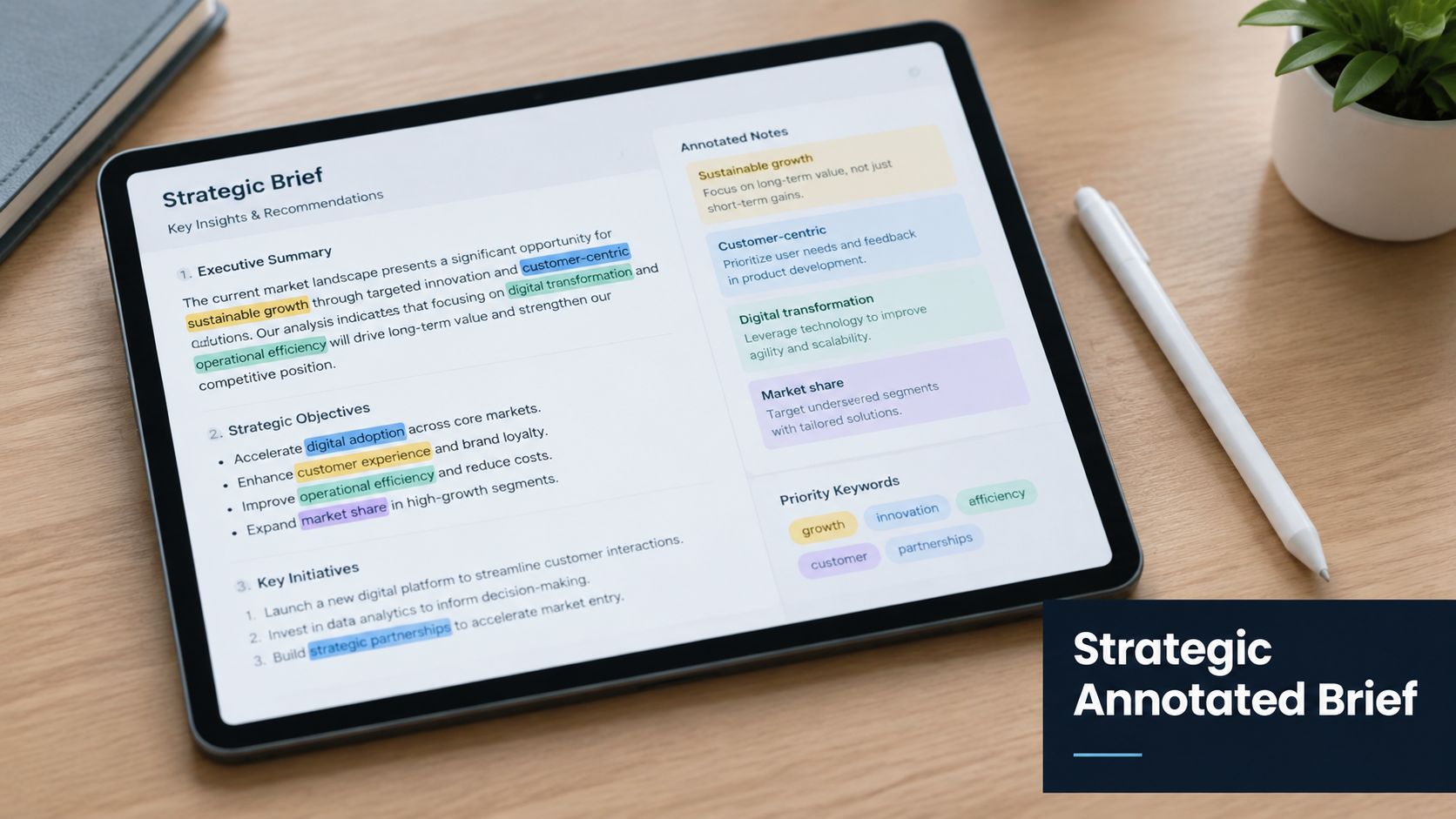
Keep strategy separate from execution
The strategic block contains the objective, keyword package, intent, audience, and angle. The outline section holds required headings, questions, and section jobs. The on-page section contains word count, metadata, links, voice, and visual requirements. Keeping those layers separate helps the writer understand which decisions are fixed and which are execution instructions.
That boundary also makes reviews cleaner. A stakeholder can approve the strategic block before the writer spends time drafting, while the editor can later check whether the finished article followed the execution specifications.
Turning the Top SERP Results Into a Brief Outline
The SERP should inform the outline, not dictate it. A repeatable process starts by reviewing the top 3 to 5 ranking pages, extracting recurring H2 and H3 themes, and converting those themes into a shared skeleton. This method is recommended in practical SERP-based content brief guidance.
Suppose the target keyword is “how to write a meta description.” The ranking pages may repeatedly address what a meta description is, how to write one, common mistakes, examples, length guidance, and how to add it to a website. Those recurring themes signal the information searchers expect.
The next step is editorial judgment. Merge headings that perform the same job, remove sections that are irrelevant to the intended audience, and add one or two differentiating sections where competing pages are thin. For this query, a useful differentiator might be a review workflow for editors or a section on writing descriptions for AI-oriented search previews, provided research supports the topic.
Extract patterns, then make decisions
| Heading Theme | Competitor Frequency | Decision in the Brief |
|---|---|---|
| Definition | Recurs across ranking pages | Keep as a concise opening explanation |
| Writing process | Recurs across ranking pages | Keep as the main instructional section |
| Examples | Recurs across ranking pages | Keep and connect each example to a principle |
| Common mistakes | Recurs across ranking pages | Keep, but focus on decisions writers can check |
| Editorial review workflow | Less consistently covered | Add as a differentiating section |
| Unrelated technical history | Occasional | Drop unless it answers a clear reader need |
Don't copy headings verbatim from one competitor. That produces a derivative draft and gives the writer no guidance about the job each section must perform. Instead, label each heading with an intent instruction such as define, instruct, compare, diagnose, or challenge.
For example, “What makes a meta description useful” tells the writer to define criteria and explain them. “How to write a meta description step by step” demands an ordered process. “Mistakes that weaken a meta description” calls for diagnosis and correction.
A tool such as this blog post outline generator can accelerate the first outline pass, but the strategist still needs to validate the result against the actual SERP and business objective. Automation can suggest structure. It can't decide which competitor gap matters to your reader.
On-Page Specifications Writers Can Measure Against
"Make it detailed" sounds useful until the writer has to decide whether the draft is finished. A strong brief replaces that phrase with measurable instructions that change the writing process.
Word count should have a minimum and maximum, derived from topic complexity and competitor depth. A target of “around 2,000 words” leaves too much room for interpretation. A bounded range tells the writer when to stop expanding and when the draft is too shallow. It also protects the editor from approving filler because the page needs to reach an arbitrary total.
Link instructions need similar precision. Identify the internal destinations, preferred anchor concepts, and the purpose of each link. For external links, specify that sources must be authoritative, relevant, and current. “Add links” produces decoration. “Link the definition to the glossary and support factual claims with primary or highly credible sources” produces a navigable page.
Specifications that affect the draft
| Spec Field | Measurable Target | Failure When Unspecified |
|---|---|---|
| Word count | A clear minimum and maximum range | The draft becomes too thin or padded |
| H1 | One page-level headline containing the main topic naturally | Multiple competing headlines weaken hierarchy |
| Title tag | Around 50 to 60 characters, when appropriate, following industry guidance from Inspace | Search-result wording becomes truncated or unfocused |
| Meta description | Around 150 to 160 characters, using the same guidance | The snippet lacks a clear promise or call to action |
| Heading hierarchy | Defined H2 and H3 structure | Writers add headings for rhythm rather than information architecture |
| Internal links | Named pages and suggested anchor meaning | Links become random or commercially awkward |
| External links | Source-trust and citation rules | Claims appear unsupported |
| Images | Count, placement, purpose, and alt-text requirements | Visuals arrive late or add no explanatory value |
| Voice | Concrete examples of preferred and prohibited tone | Editing becomes subjective and repetitive |
Use the mental test: if I removed this field, what would the writer do differently? If the answer is “nothing,” cut the field. A brief should reduce decisions, not create administrative noise.
The H1 and title tag don't have to be identical. The H1 can prioritize clarity for the page reader, while the title tag can be shaped for search-result presentation. The meta description should summarize the page's value rather than repeat a keyword list. Headings should make the information architecture visible, and tone guidance should include examples, not only adjectives such as “professional” or “friendly.”
The Reusable SEO Content Brief Template
A reusable template works when a writer can receive it cold and begin without a chain of clarification messages. It should preserve strategic context while making execution fields concrete. Teams can adapt the following structure in Notion, Google Docs, or a project-management system.
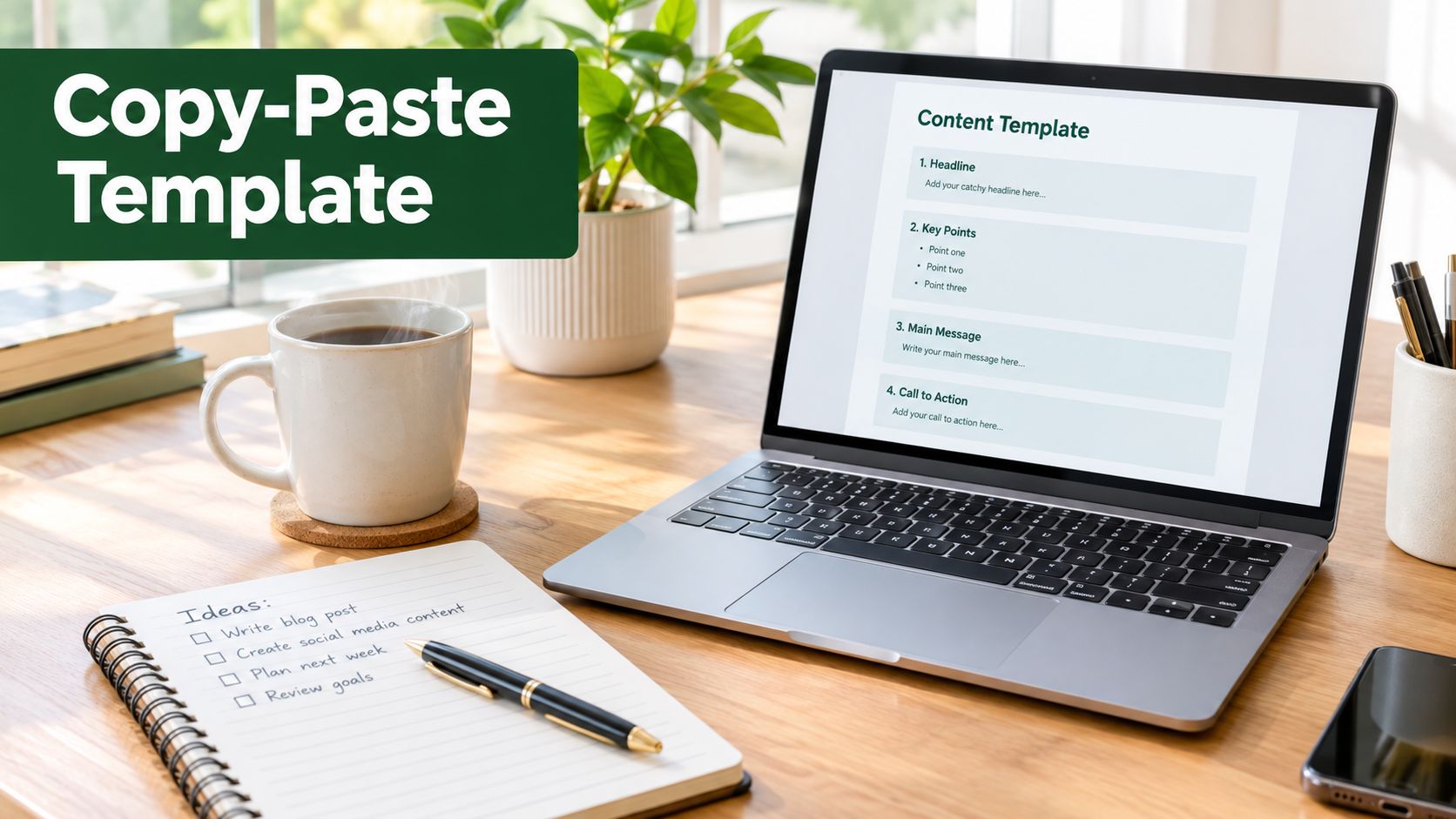
Copy-paste template
Objective
- Business purpose: [What should this page help achieve?]
- Success condition: [What outcome will indicate that the page did its job?]
- Page type: [Informational article, comparison, landing page, review, or other format]
Audience
- Primary reader: [Role, experience level, and situation]
- Immediate problem: [What prompted the search?]
- Next decision: [What should the reader understand or do afterward?]
Keyword and intent package
- Primary keyword: [One central phrase]
- Search intent: [State the intent in one sentence, not only “informational”]
- Secondary keywords by theme: [Group terms under subtopics]
- Required questions: [Questions the body must answer]
Angle
- Editorial position: [What makes this page meaningfully different?]
- Brand perspective: [Relevant point of view, limits, or examples]
SERP outline
- Research set: [Ranking pages reviewed]
- Required H2s and H3s: [Heading, intent job, and notes for each]
- Competitor gaps: [Differentiating sections to add]
- Exclusions: [Topics that don't serve the intent]
On-page specifications
- Word-count floor and ceiling: [Range]
- H1: [Working headline]
- Title tag: [Search-result headline]
- Meta description: [Description and CTA]
- Voice: [Two preferred examples and two prohibited patterns]
- Visuals: [Assets, placement, and alt text]
Links and sources
- Internal links: [Destination, anchor concept, and placement]
- External sources: [Evidence standard and approved research]
- Citation notes: [Claims requiring support]
FAQs
- Qualifying questions only: [Question, intent, placement, and answer direction]
- Exclusions: [Questions already answered in the body]
AI-search fields
- Citable claims: [Claim, source, publication or review date, and context]
- Structured answer pairs: [Direct answer followed by support for each H2]
- Schema assignment: [Article, HowTo, FAQPage, Organization, or other applicable type]
- Freshness signal: [Last reviewed date, update cadence, and change-log requirement]
Acceptance criteria
- Required headings are present
- Intent is satisfied directly
- Metadata follows the specified limits
- Links are relevant and functional
- Claims have required sources
- FAQs meet the qualification rules
- Draft matches voice and audience
Don't leave intent as “informational” without explaining the reader's task. Don't list keywords without grouping them by topic or SERP feature. Don't omit the word-count floor and ceiling. A template is valuable because it captures decisions that otherwise disappear into meetings and messages.
Teams building repeatable workflows can compare this structure with content creation workflows that scale AI-driven content with LLMrefs. For prompt-assisted drafting, an AI content creation workflow can also help convert the approved brief into controlled prompts, provided the brief remains the source of truth.
The template should be quick enough to complete during planning, but not so compressed that it hides important choices. The right test is operational: can the writer resolve the likely questions from the document alone?
The AI-Search Fields Most Briefs Still Leave Out
Classic briefs are built for blue-link competition. They specify keywords, headings, and metadata, but often fail to describe how content should be excerpted, cited, or rephrased by AI Overviews and other answer systems. Guidance for 2026 increasingly identifies this as a coverage gap, especially because many templates still lack explicit claims, source notes, structured answers, schema directives, and freshness signals, as outlined in this AI-search content brief guidance.
The missing fields are practical, not theoretical.
Four additions to make
- Citable claims register: List factual claims, their sources, review dates, and a note on whether the sentence can stand alone without surrounding context. Without this, writers may include accurate ideas that editors can't verify efficiently.
- Structured answer pairs: Require a direct answer immediately after each H2, followed by supporting explanation. Without this instruction, the writer may bury the answer under background.
- Schema assignment: Identify whether the page calls for Article, HowTo, FAQPage, Organization, or another relevant schema type. Without an assignment, implementation becomes a late publishing task.
- Freshness signals: Record the last-reviewed date, update cadence, and change-log expectation. Without those fields, teams know a page needs maintenance but can't define what maintenance means.
| Field | Classic Brief | AI-Search Brief |
|---|---|---|
| Claims | General research instruction | Claim-by-claim source and review notes |
| Answers | Headings and paragraphs | Direct answer followed by supporting context |
| Schema | Often omitted | Assigned by page type and content function |
| Freshness | Publish date only | Review date, cadence, and recorded changes |
| Quotability | Assumed | Deliberately written and reviewed |
A claim register doesn't mean every sentence needs a citation. It means the team can identify which statements require evidence and attach the source before publication. That protects accuracy while making the draft easier to review.
The same principle applies to AI-assisted writing. A prompt can generate fluent copy, but it won't reliably know which claims need sourcing or which answer should lead an H2. The brief has to specify those constraints. Teams exploring that workflow can use this guide to using AI for SEO as a practical reference point.
Editorial standard: Quotability is a writing requirement, not a lucky outcome of publishing a well-optimized page.
FAQ Strategy in a Brief That Actually Earns Its Place
Appending a generic FAQ block to every article is easy, but it often produces repetition. The stronger question isn't whether a page should contain FAQs. It's which questions deserve separate treatment, where they belong, and what the main body should answer instead.
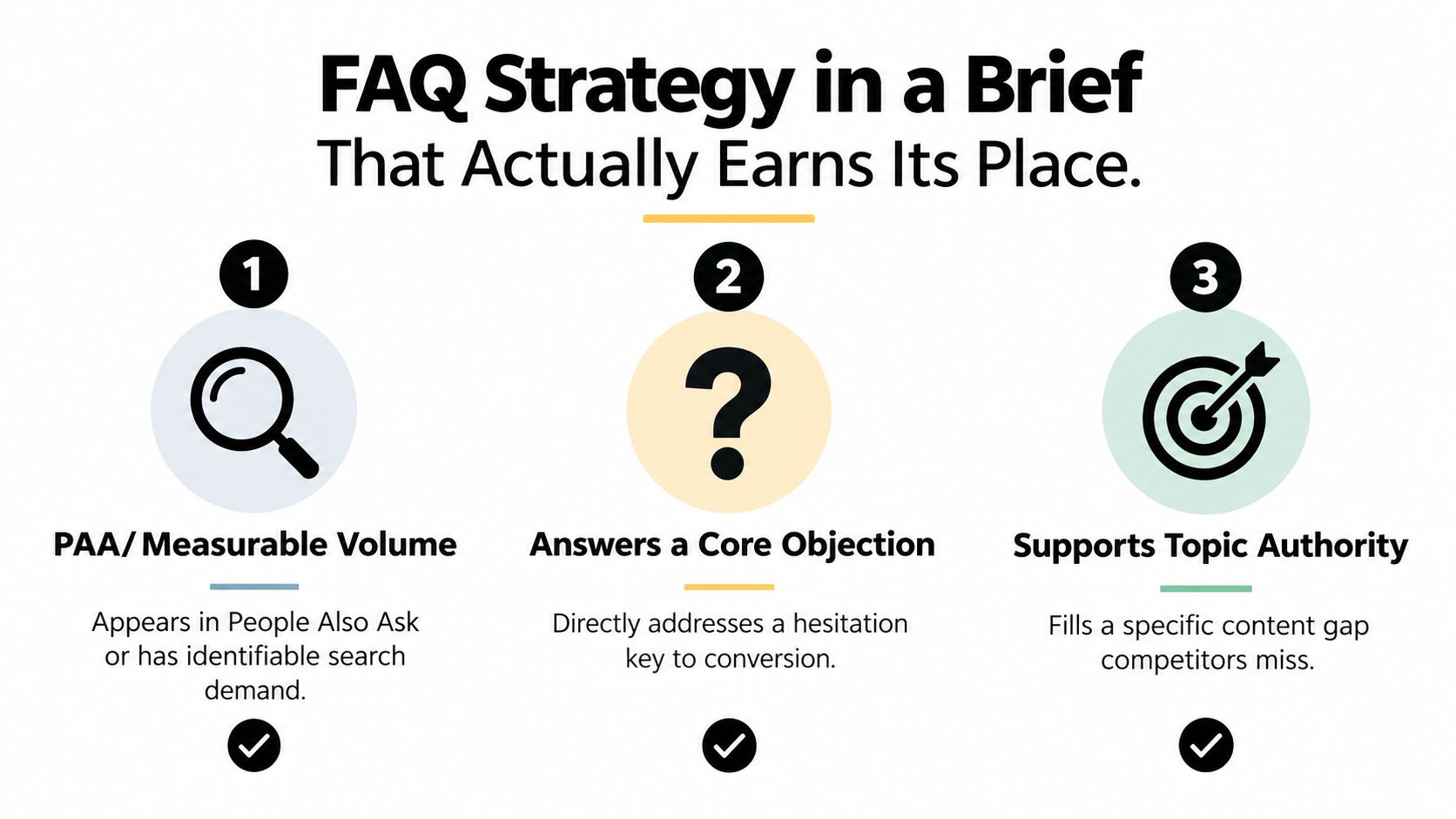
A question earns FAQ space when it meets clear criteria:
- Search evidence: It appears in People Also Ask or has identifiable search demand.
- Distinct coverage: The main body doesn't already answer it cleanly.
- Reader value: It addresses a separate objection, uncertainty, or decision.
The FAQ content brief guidance from Early SEO emphasizes the need for specific questions, limited coverage, placement instructions, and internal-link direction rather than a generic add-on.
Place questions where they help
Put an FAQ immediately after the section it supports when the question is a natural objection to that explanation. Use a dedicated FAQ section only when three or more qualifying questions form a coherent cluster. A page about SEO content briefs might retain a question about whether freelancers should create their own briefs if the main article focuses on strategist-led workflows. It should cut a question that merely asks readers to repeat a definition already answered in the opening.
Write each answer directly, keep it within the brief's specified answer range of 40 to 70 words, and link it back to the relevant body section when that connection improves navigation. Apply FAQPage schema only when the visible page contains the qualifying questions and answers. Schema shouldn't be used to disguise boilerplate.
A useful FAQ field includes the question, evidence or search rationale, placement, answer direction, and exclusion note. That final note matters because it prevents the writer from creating a duplicate paragraph just to fill a block.
The Editor's Checklist for Grading a Draft Against the Brief
Editors need a shared standard, not a personal impression of whether the article “feels SEO-friendly.” Grade the draft against the brief field by field, using pass, partial, or fail.
Objective and intent
- Pass: The draft serves the stated business purpose and answers the intended search task.
- Partial: The topic is relevant, but the reader's next decision or business role is weakly addressed.
- Fail: The article follows the keyword while serving a different audience or page purpose.
Check whether the primary keyword appears naturally in the title, H1, opening copy, and at least one relevant subheading, following the on-page guidance specified in the brief. Presence alone isn't enough. The article must match the intent classification.
Outline and specifications
- Pass: Every required heading appears, the order is sensible, and unauthorized sections haven't changed the page's purpose.
- Partial: A required idea appears under a different heading or one section needs restructuring.
- Fail: Core sections are missing or the draft follows a competing intent.
Confirm that the draft sits within the specified word-count range, that title and meta instructions have been followed, and that internal and external links are live, relevant, and placed naturally. Check voice against the examples in the brief, not against an editor's personal preference.
AI-search and FAQ review
Every H2 should begin with a clear, quotable answer when the brief requires structured answer pairs. Claims listed in the register should have their source and review information. Schema assignments should be explicit for the publishing team.
FAQs pass only when the questions qualify, answers follow the required length, placement makes sense, and markup matches the visible content. A single fail blocks publication until someone fixes it or records an approved exception. Checklists work when they close the workflow, rather than merely documenting problems after release.
Quick-Reference Brief Card to Pin Next to the Writer
Keep this card visible during drafting. Required fields are essential. Optional fields can be used when they support the page rather than add ceremony.
Objective and primary keyword, REQUIRED
Objective: [Business outcome and page role]
Primary keyword: [Central search phrase]
Intent and audience, REQUIRED
Intent: [The reader's task in one sentence]
Audience: [Role, knowledge level, problem, and next decision]
Core on-page specifications, REQUIRED
Word count: [Minimum to maximum]
H1: [Reader-facing headline]
Title tag: [Search-result headline]
Meta description: [Value statement and CTA]
Required structure, REQUIRED
Headings: [H2s, H3s, section intent, and competitor gaps]
Questions: [Must-answer questions and exclusions]
Links and assets, REQUIRED
Internal links: [Destinations, anchors, and placements]
External sources: [Evidence standards]
Assets: [Tables, images, videos, alt text, or downloads]
AI-search and FAQ flags, REQUIRED when applicable
Claims register, structured answer pairs, schema, freshness notes, qualifying FAQs, and placement instructions.
Before submitting, compare the draft against the acceptance criteria and mark each item pass, partial, or fail. A brief should make that self-check possible without another Slack thread.
Prompt Builder helps teams generate, refine, test, and organize model-specific prompts for work such as SEO outlines and content briefs. Visit Prompt Builder to turn an approved brief into a reusable prompt workflow, then iterate and save the versions your team uses most.
Tags
Related Posts
SEO Content Brief Generator Explained and How to Use It
September 17, 2026
Scaling Content Production: A Practical Playbook for 2026
August 11, 2026