
SEO Content Brief Generator Explained and How to Use It
Your writer has finished the article, but the draft still misses the target. The headings sound reasonable, the keyword appears in all the expected places, and the prose is polished. Yet the article answers a buying question when readers wanted a practical tutorial, skips questions visible in search results, and gives the writer no guidance on internal links or content depth. The team now faces another round of research, revision, and editorial debate.
That problem usually starts before writing. A seo content brief generator can turn a topic into a structured plan, but only when you understand what the tool is analyzing, when its recommendations are reliable, and when human judgment needs to override the template. The useful question isn't which generator produces the longest outline. It's which briefing method fits the query, the audience, and the distribution plan.
Table of Contents
- Why Great Content Starts Before You Write
- What an SEO Content Brief Generator Really Does
- How an SEO Content Brief Generator Works Behind the Scenes
- Manual Briefs Versus Generated Briefs
- Key Features to Look for in a Generator
- Inside a High Performing SEO Content Brief Template With Examples
- Integrating Generated Briefs Into Your Content Workflow
Why Great Content Starts Before You Write
A weak brief creates expensive confusion. The writer interprets the topic one way, the strategist expects another angle, and the editor discovers the mismatch only after a full draft exists. By then, changing the search intent can mean rebuilding the introduction, headings, examples, links, and conclusion rather than polishing a few sentences.
The problem becomes more visible as a team publishes more often. In the 2026 content-marketing data cited by Amra & Elma's SEO and content marketing statistics, 91.2% of organizations were using content marketing, and organizations publishing at least 16 pieces per month reported 4.2x more website traffic than those publishing four or fewer pieces. Those figures don't prove that volume alone creates results. They do show why teams need repeatable planning when output expands.
Practical rule: A brief should remove important decisions from the writing stage, not remove the writer's judgment.
Consider an article targeting “customer onboarding software.” A keyword list might tell the team what phrase to include, but it won't settle whether readers want a software comparison, an implementation guide, a definition, or a pricing page. A useful brief records that decision, identifies the audience's knowledge level, sets the heading logic, and explains which questions the article must answer.
This is also where broader resources on strategic content for startups can help teams connect individual articles to positioning, audience needs, and business priorities. The brief becomes more valuable when it reflects the role of the article in the larger content system.
A generator promises to make that planning faster and more consistent. It can organize research, surface recurring topics, and give a writer a defensible starting point. It can't decide whether your company has something useful to add, whether a competitor's structure fits your brand, or whether a novel topic needs a different approach.
The practical path is straightforward:
- Understand the artifact: Learn what a generator produces and where it fits in the content lifecycle.
- Inspect the evidence: See how live search results, intent signals, entities, and questions shape the output.
- Choose the method: Decide between manual, generated, and hybrid briefing.
- Apply the template: Build a lean brief that gives writers direction without turning the article into a cloning exercise.
- Close the loop: Use editorial feedback and performance data to improve future briefs.
What an SEO Content Brief Generator Really Does
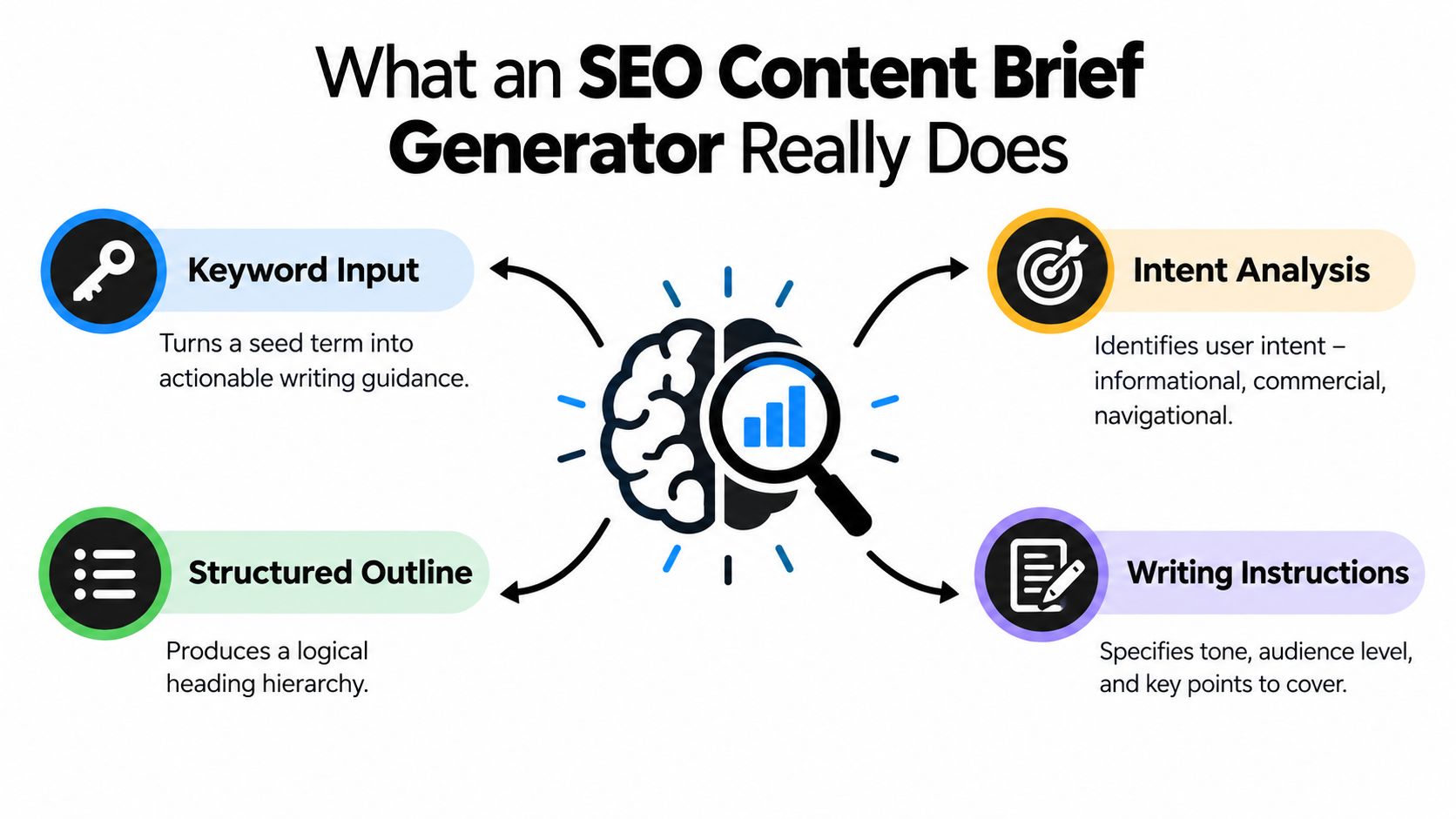
An SEO content brief generator is a planning assistant. It takes a keyword or topic, studies relevant search and content signals, and turns them into instructions that a writer can use before drafting begins.
Think of an architect's blueprint. A blueprint doesn't build the house, and it doesn't replace the architect's decisions about the client's needs. It gives builders a shared plan for rooms, dimensions, materials, and sequence. A content brief plays the same role for a strategist, writer, editor, and SEO lead.
The generator's job
A useful generator generally helps define:
- The primary topic: The central query or subject the page should address.
- Search intent: The reason behind the search, such as learning, comparing, evaluating, or finding a specific destination.
- The outline: A logical H1, H2, and H3 structure that gives the draft a clear progression.
- Coverage guidance: Related concepts, entities, questions, and gaps the writer should consider.
- Writing constraints: Audience level, tone, content depth, title direction, and sometimes metadata or linking prompts.
That makes the tool different from a keyword research platform. A keyword tool helps identify search terms and related demand signals. A generator uses those inputs, often alongside live search analysis, to explain what the article should do with them.
It's also different from an AI writing tool. A writer produces the article. A brief generator prepares the decisions and guardrails that make the article easier to produce and review. Some products combine both functions, but the workflow stages remain distinct.
Finally, a generator shouldn't be treated as an outline copier. Competitor headings are evidence of what appears in the current results, not a command to reproduce every section. Your brief still needs an original angle, accurate information, useful examples, and a reason for readers to choose your page.
SEO content brief generators emerged during a broader shift toward structured, data-driven content planning. By 2026, SEO's average ROI was reported at $27.40 for every $1 spent, up 24.5% from 2024, while B2B companies were seeing $34.10 per dollar invested. The same source connected AI-powered content optimization tools with a 38% reduction in average content production costs. These figures help explain why planning tools attract attention, but they don't turn a generator into an automatic growth engine.
Teams that want to develop the planning skill itself can also browse content strategy resources for broader guidance. The generator works best when the team already understands the audience, offer, and purpose behind the page.
How an SEO Content Brief Generator Works Behind the Scenes
Suppose a team receives a topic with little useful search history. A generator cannot just copy competitor headings and call the result a strategy. It needs to decide whether the SERP provides reliable evidence, then build a brief around what is known, what is uncertain, and what the page must contribute.
From query to search pattern
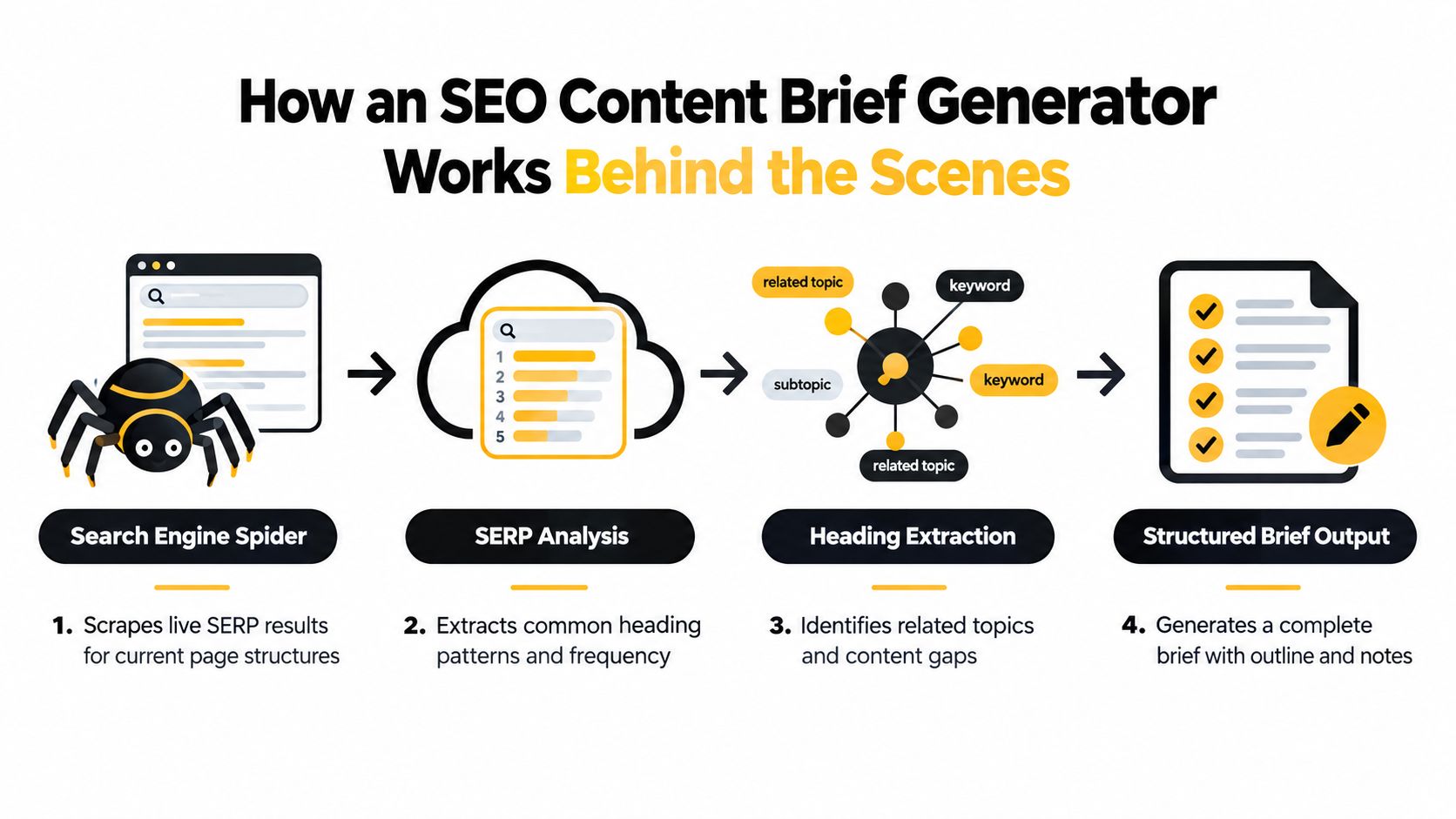
For an established topic, the workflow begins with a live SERP rather than a static keyword list. Semrush's documentation for its SEO Brief Generator describes extracting the top 10 results, then using their structures to produce outline and keyword guidance.
The generator may examine:
- Heading hierarchies: Subtopics that appear under H2 and H3 headings.
- Content depth: How fully ranking pages address the subject.
- Semantic coverage: Related terms, entities, definitions, and supporting concepts.
- Question patterns: People Also Ask questions and recurring information needs.
- SERP opportunities: Formats suited to a direct answer, list, definition, or comparison.
Those observations become writing constraints. A useful brief might sequence a definition, an explanation of how the topic works, a comparison, common questions, and implementation guidance. The writer then adds the examples, point of view, and evidence that make the page worth reading.
Why broader sampling can matter
Some tools examine a wider set of results. Thruuu's content brief generator describes using 100 SERP results plus AI Overview citations, with real-time competitor analysis, keyword difficulty, search volume, and entity or readability metrics.
A broader sample can expose recurring subtopics that a small group misses and reduce dependence on an unusual competitor structure. It can also show that different formats answer different parts of one query. Results may vary by country, language, device, and content type, so the selected context affects the brief.
SERP-driven briefing works best when the results reveal a stable pattern. Thin-SERP topics require a different decision. If ranking pages are sparse, inconsistent, or aimed at different intents, the generator should produce a lean brief rather than imitate weak evidence. That brief might define the audience, page purpose, core answer, supporting proof, and a small set of questions to resolve. Model-driven guidance can fill planning gaps, but the team must verify facts and supply first-hand expertise.
Inputs also shape the output. Location, language, device context, chosen competitors, and SERP freshness can change recommendations. Treat observed patterns as evidence, not mandatory instructions. If ranking pages commonly include pricing, the team should assess whether readers need it and whether the brand can publish it.
Teams automating this workflow can use model tuning techniques to make instructions more consistent. The practical rule is simple: use search evidence when it is dependable, use model reasoning when the SERP is thin, and apply editorial judgment in both cases.
Manual Briefs Versus Generated Briefs
A strategist briefing a new, branded, or sensitive topic may discover the angle in a sales call, customer wording, or product detail. That context can prevent the team from copying a competitor structure that does not fit the brand. Manual work also takes longer and can vary between strategists.
Generated briefing works like a repeatable research assistant. It applies the same fields, examines available search results, and produces a starting outline, so each writer does not repeat the same groundwork. The document still needs scrutiny. A polished brief can reflect the wrong intent, stale assumptions, or a competitor format that offers little value.
| Criteria | Manual Brief | Generated Brief |
|---|---|---|
| Speed | Slower when research is extensive | Faster first draft for recurring topics |
| Consistency | Depends on the strategist's process and template discipline | Applies repeatable fields and output patterns |
| SERP alignment | Strong when the strategist studies results carefully | Strong when the tool uses current SERP data |
| Originality | Easier to add brand insight and a distinct angle | Needs review to avoid copying outlines |
| Novel topics | Better for weak or unstable search results | May struggle when ranking evidence is limited |
| Editorial judgment | Part of the briefing process | Added during review |
| Scale | Limited by strategist capacity | Easier to apply across a larger publishing program |
Some generators expand the research pool by examining more search results and AI Overview citations, alongside competitor, keyword, and entity information. That wider view can reveal patterns a small sample misses. It remains evidence for a decision, not a decision itself. A recurring topic may still deserve a different structure because of the audience, brand expertise, or business purpose.
The hybrid choice
For a marketing team, the practical workflow combines both methods. Let the generator collect patterns, group questions, and draft a structure. Then have a strategist revise the angle, remove irrelevant sections, add proprietary knowledge, define the audience, and approve the handoff.
Choose manual briefing first for new, branded, sensitive, or thin-SERP topics. In those cases, the team may need a lean brief that defines the audience, page purpose, core answer, supporting proof, and questions to resolve. Use generated briefing for a stable SERP and repeatable production. The generator is a workflow decision tool, not merely a SERP scraper. It helps the team decide how much evidence to use and where human judgment must lead.
The writer should receive approved decisions, not a data dump.
A generated brief should shorten research, not shorten thinking.
Key Features to Look for in a Generator
A tool's feature list can look impressive while offering little beyond competitor outline extraction. Evaluate the workflow, not the number of fields on the screen. The right generator helps your team make better decisions before writing and gives the writer enough context to execute them.
Research and intent controls
Start with the evidence layer. The tool should make clear whether it analyzes live SERPs, which pages it samples, and how it handles different result types. A small, transparent sample is more useful than a large mystery score because the strategist can inspect the underlying pages.
Look for intent clustering rather than a single label. “Informational” may describe the broad query, but the page could still need a definition, a process, a comparison, or an example. The generator should help the team distinguish the main job from related questions.
Keyword guidance should also include entities and concepts, not just repeated phrases. A writer needs to know which ideas to explain, how they relate, and where a topic might be incomplete. Keyword gap detection is useful when it reveals missing coverage, but it shouldn't turn the brief into a checklist of competitor vocabulary.
Editorial and operational controls
A practical generator should support the decisions editors manage.
- Audience and tone settings: The same topic needs different explanations for beginners, practitioners, executives, or technical buyers.
- Outline editing: Strategists must be able to remove, reorder, merge, and add sections before handing the brief to a writer.
- Readability guidance: The tool should help match language complexity to the audience without forcing every article into the same voice.
- E-E-A-T prompts: Include reminders for first-hand experience, trustworthy sourcing, author expertise, and transparent limitations where relevant.
- Internal link and schema prompts: A brief should connect the new page to the existing site and identify structured-data considerations when appropriate.
- Export and collaboration: Writers and editors need a clean document they can comment on, revise, and version.
A trial should answer practical questions. Can the strategist see why a heading was recommended? Can the team add a company-specific point? Can the writer tell what not to cover? Can an editor distinguish required guidance from optional suggestions?
The best tool isn't necessarily the one with the longest output. It's the one that leaves the team with a clear, reviewable plan.
Inside a High Performing SEO Content Brief Template With Examples
A strong brief is specific enough to guide a writer and flexible enough to preserve judgment. For a page about an SEO content brief generator, a reusable template might look like this:
The brief fields
- Primary keyword: SEO content brief generator.
- Secondary concepts: Content brief template, SEO writing guide, search intent analysis, SERP research, internal linking.
- Search intent: Informational. The reader wants to understand the tool and learn how to use it.
- Audience: Intermediate marketers who understand basic SEO but need a repeatable briefing process.
- Working title: How to Use an SEO Content Brief Generator, a Step-by-Step Guide.
- Reader promise: Explain what the generator does, show how it makes recommendations, and teach the reader when SERP-driven or model-driven briefing is appropriate.
- Outline: Definition, workflow, manual comparison, feature evaluation, template example, implementation.
- Questions to answer: What does the tool analyze? How is it different from keyword research? What happens when the SERP is thin? What should a writer receive?
- Linking prompts: Add relevant internal pages, cite trustworthy external evidence, and identify any product or service pages that genuinely help the reader.
- Content specifications: Set the tone, audience level, format, approval owner, and requirements for examples, sources, and updates.
A writer can use a blog post outline generator for an initial structure, but the strategist should still validate the result against the query and the business objective. The outline is a working model, not the finished brief.
Adapting the template to intent
For an informational query such as “how does inventory forecasting work,” the brief should prioritize explanation, terminology, process steps, assumptions, and practical examples. A commercial query such as “inventory forecasting software” needs a different structure, perhaps evaluation criteria, implementation considerations, integrations, limitations, and a clear path to compare solutions.
The template also changes when the SERP is thin or unstable. Distribb's comparison of AI content brief approaches distinguishes between SERP-driven generators, which work best when useful pages already rank, and model-driven approaches, which can help when a meaningful SERP doesn't yet exist.
For an emerging topic, begin with the reader's job to be done. Define who needs the answer, what decision they're trying to make, what they already understand, and which adjacent entities can clarify the subject. Then use whatever SERP evidence exists as validation rather than as the source of truth.
Lean brief principle: If the topic is novel, audience and purpose should lead. Search data should inform the plan without dictating it.
Integrating Generated Briefs Into Your Content Workflow
A generator creates value only when the brief survives contact with the team. Start by assigning ownership. The strategist owns intent, audience, angle, and business relevance. The writer owns explanation, examples, voice, and factual execution. The editor owns coherence, accuracy, source quality, and compliance with the brief.
Use a short handoff process:
- Strategist reviews the draft: Remove irrelevant headings, add unique insight, and mark required versus optional guidance.
- Writer challenges assumptions: Ask whether the intended reader, format, and depth are clear before drafting.
- Editor checks the finished article: Compare the draft with the brief, but don't reward mechanical keyword insertion or competitor imitation.
- Team records lessons: Note which instructions helped, which created confusion, and which reader questions remained unanswered.
The brief shouldn't become a fixed document that nobody updates. Search patterns change, products change, and editorial learning accumulates. Feed those observations into the next brief so the system improves through use.
A single brief can also support more than an article. Coverage on AI content creation trends in 2026 describes multimodal generation as a defining shift, with platforms producing text, image direction, short-form video scripts, and audio narration from one brief. The same coverage notes that SEO guidance now reaches beyond headings and keywords to include internal links, schema, E-E-A-T, featured-snippet strategy, and external citation requirements.
That changes what a brief needs to contain. Add distribution constraints, repurposing ideas, visual requirements, video angles, and channel-specific calls to action when the page belongs to a broader content package. A lean brief that captures audience, format, and distribution can be more useful than a crowded outline built only from SERP patterns.
Teams scaling production can also use a content production scaling workflow to formalize assignments, reviews, and reuse. For a practical test, choose one stable query and one thin-SERP topic, generate briefs for both, then have a strategist compare the recommendations with the team's own judgment.
Prompt Builder offers prompt generation, refinement, testing, and reusable templates for workflows such as SEO research and content briefing. Visit Prompt Builder to create a structured briefing prompt, adapt it to your chosen model, and turn the approved format into a repeatable team process.
Tags
Related Posts
SEO Content Brief Example: The Complete Template
September 10, 2026