
SEO Driven Content Marketing: A 2026 Playbook
Publishing more blog posts isn't a content strategy. It's a production habit, and in 2026 it's an expensive one. Search has long been a core acquisition channel, with organic search accounting for 53% of trackable website traffic in BrightEdge's 2019 research, while organic and paid search together drove 68% of trackable traffic. The same summary found that unbranded search discovered 88% of B2B sites and 58% of consumer retail sites, which is why search visibility still matters before a buyer knows your name. (BrightEdge data summarized by SEO.com)
But the page that wins a blue-link ranking isn't automatically the page that gets retrieved in an AI Overview, quoted by an answer engine, or surfaced in a Reddit discussion. SEO-driven content marketing now has two jobs: earn conventional rankings and make useful information easy for machines and communities to retrieve, verify, and reuse.
The teams that outperform won't split those jobs into separate departments. They'll build one research, production, linking, and measurement workflow that serves both surfaces.
Table of Contents
- What SEO Driven Content Marketing Actually Means in 2026
- The Core Concept Behind SEO Driven Content
- Keyword Research and Intent Mapping
- Content Frameworks and Topic Clusters
- Model-Assisted Content Generation and Optimization
- Measuring What SEO Content Actually Changes
- Scaling the Workflow Without Burning the Brand
What SEO Driven Content Marketing Actually Means in 2026
SEO-driven content marketing is the deliberate creation of search-led business assets, not the manufacture of blog posts. Each asset should answer a defined demand, match the format users expect, establish a reason to trust the answer, and lead the reader toward a useful next action.
That asset may be a product comparison, implementation guide, glossary, original research report, documentation page, calculator, or community response. The format follows the problem. A keyword list alone can't make that decision.
The old model treated traditional search and emerging answer surfaces as separate programs. One team optimized titles, headings, links, and schema for Google. Another team tried to make brand information appear in AI answers and online communities. That split creates duplicated research, inconsistent claims, and fragmented authority. A strong source should be useful wherever a searcher encounters it.
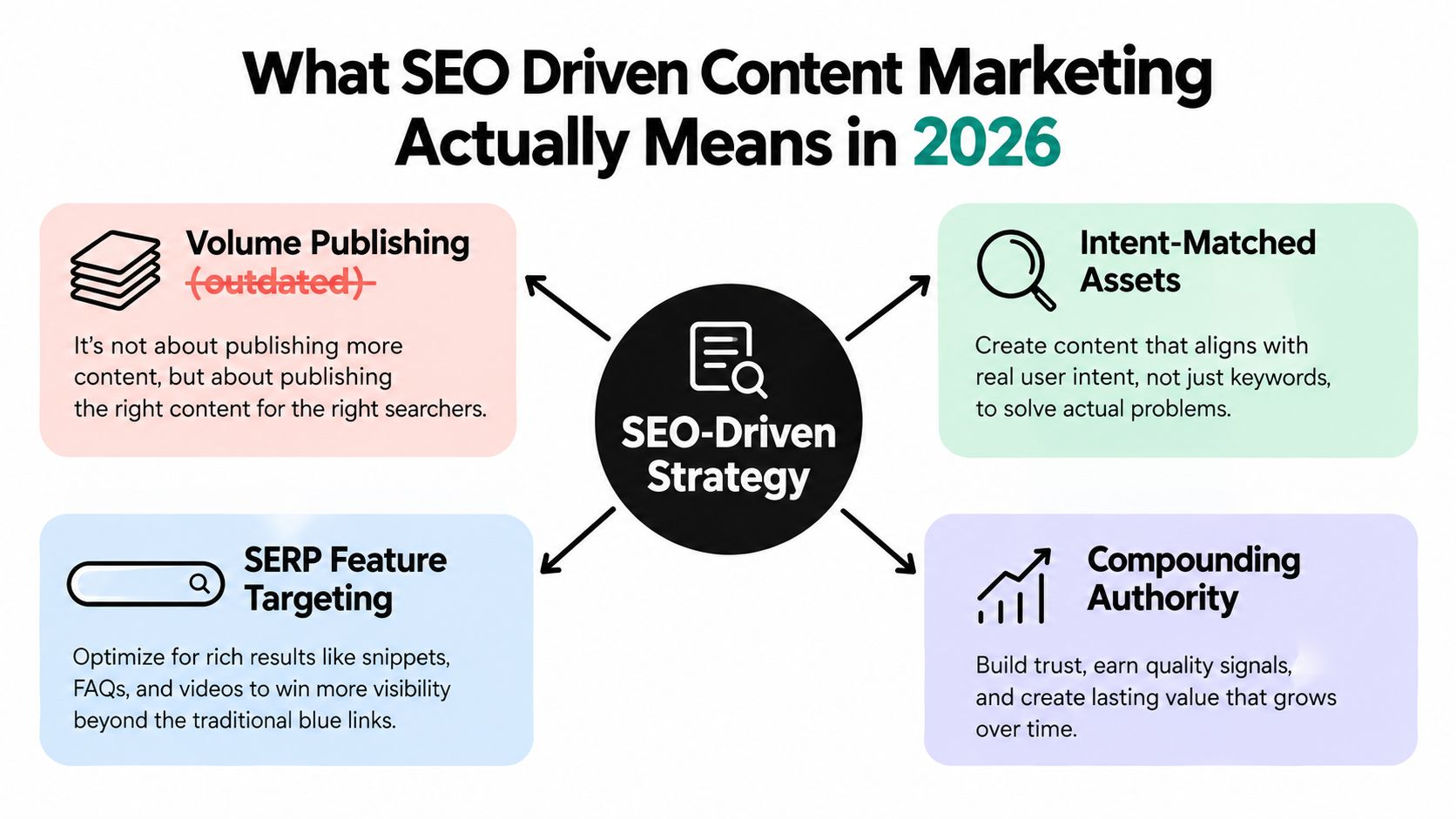
Build for retrieval, not just ranking
A retrievable page makes its answer obvious. It uses descriptive headings, short passages that resolve specific questions, visible evidence, consistent terminology, structured data where appropriate, and links to authoritative supporting material. It doesn't bury the answer under brand theatrics or a long introduction.
This also changes how marketers view communities. Recent industry coverage describes Reddit and Quora as increasingly visible in search while AI Overviews and answer engines increase the value of clarity, direct answers, schema, and retrievability. (Semrush coverage of content marketing trends) Community visibility can't be manufactured by copying a blog post into a forum. It comes from contributing a specific answer in the language and context of that community.
A practical dual-surface workflow must deliver:
- Intent alignment: Match the page to what the searcher is trying to accomplish.
- Information architecture: Connect the page to a coherent topic cluster.
- Evidence quality: Support important claims with original data, expert input, or clear documentation.
- Retrievability: Make answers, entities, definitions, and relationships easy to identify.
- Commercial usefulness: Give qualified readers a credible next step without forcing a sales pitch.
- Feedback loops: Use rankings, queries, conversions, and citation observations to improve the asset.
For teams building AI-assisted marketing workflows, this guide to using AI for marketing is useful context. The tool can accelerate production, but the strategy still belongs to the people who understand the audience, product, and commercial stakes.
The Core Concept Behind SEO Driven Content
Think of SEO-driven content like a restaurant kitchen. The restaurant doesn't invent a random meal every time someone walks through the door. It studies demand, plans a menu, prepares ingredients, follows recipes, plates each dish clearly, and watches which meals customers order again.
Keyword research is the menu. It shows the questions, problems, comparisons, and product categories people bring to the search bar. The menu isn't the final meal, though. A list of keywords without context is just inventory.
The search query is the order ticket. It tells you what the customer asked for, but not always what they expect to receive. Someone searching for “project management software” may want a category overview, a shortlist, pricing information, or a product page. The words alone don't settle the question.
SERP intent is the customer's mood. Informational visitors want to understand. Commercial investigators want to compare. Transactional searchers want to act. Navigational searchers already have a destination in mind. Read the results page to identify the mood. If Google consistently shows comparison pages, a broad educational essay is the wrong dish.
The recipe controls consistency
The content framework is the recipe. It determines the opening, quick answer, sub-intents, examples, objections, FAQs, and conclusion before anyone starts drafting. A good recipe gives writers room for judgment while preventing them from forgetting the information a reader needs.
The published page is the plated dish. On-page optimization is the plating: a useful title, clear H1, scannable subheadings, descriptive links, concise answers, relevant media, and a visible conversion path. Presentation doesn't rescue poor ingredients, but poor presentation can hide a good answer.
The final step is service and adjustment. Review Search Console queries, engagement behavior, conversions, and feedback from sales or support. Add the missing answer, clarify the confusing section, fix the weak internal link, or change the page format if the SERP has moved.
Practical rule: Don't ask whether a writer can produce more words. Ask whether the kitchen can repeatedly serve the right answer to a known demand.
Keyword Research and Intent Mapping
Keyword research should start with business reality, not a tool export. Ask sales which objections appear in late-stage calls. Ask support which problems customers repeatedly describe. Ask product teams which workflows the product handles better than alternatives. Turn that language into a seed list, then expand it with competitor gaps, Search Console queries, related searches, and community discussions.
Next, classify each term by the intent visible in the SERP:
- Informational: The searcher wants an explanation, process, definition, or diagnosis.
- Commercial investigation: The searcher is evaluating solutions, vendors, alternatives, or trade-offs.
- Transactional: The searcher is ready to sign up, buy, request a demo, or complete an action.
- Navigational: The searcher is looking for a specific brand, feature, document, or destination.
Don't trust the label until you inspect the live results. A phrase that sounds informational may produce product pages. A phrase that includes “best” may produce review articles, listicles, forums, or category pages. Record the dominant format, recurring subtopics, visible competitors, SERP features, and the strength of the current results.
A worked prioritization model
The table below uses qualitative difficulty because difficulty scores vary by tool and market. Business priority should reflect commercial relevance, evidence of demand, and whether your site can produce a materially better answer.
| Keyword | SERP-Validated Intent | Difficulty | Business Priority |
|---|---|---|---|
| how to build an SEO content brief | Informational, process guide | Medium | High |
| SEO content brief template | Informational, template | Medium | High |
| SEO content marketing | Informational, strategic guide | High | High |
| content marketing SEO strategy | Informational, framework | High | High |
| SEO content services | Commercial investigation | High | High |
| content SEO agency | Commercial investigation | High | High |
| SEO content writing service | Commercial investigation | Medium | High |
| content optimization software | Commercial investigation | High | High |
| AI SEO content workflow | Informational, workflow guide | Medium | High |
| AI content brief generator | Commercial investigation | Medium | High |
| how to optimize old blog posts | Informational, how-to guide | Medium | Medium |
| SEO content audit checklist | Informational, checklist | Medium | High |
| topic cluster example | Informational, example-led guide | Medium | Medium |
| internal linking strategy for SEO | Informational, tactical guide | High | High |
| content cannibalization | Informational, diagnosis | High | Medium |
| content cannibalization tool | Commercial investigation | Medium | High |
| SEO reporting for B2B | Informational, measurement guide | Medium | High |
| organic content attribution | Informational, measurement | Medium | High |
| AI Overview content optimization | Informational, emerging practice | High | High |
| Reddit SEO strategy | Informational, community workflow | Medium | Medium |
This SEO research workflow can help structure query expansion, SERP analysis, clustering, and brief creation. Use it to reduce manual sorting, not to outsource judgment.
Reject a keyword when the SERP's dominant intent conflicts with your offer, your evidence, or your ability to create a better result. High apparent demand doesn't compensate for a mismatch that produces unqualified visitors and a weak page.
Content Frameworks and Topic Clusters
Outlines are cheap. Frameworks are reusable production systems. An outline tells one writer what to write once. A framework tells a team how to produce a consistent class of pages without flattening every topic into the same article.
A dependable informational framework might include a direct answer, why the issue matters, the main process, decision criteria, examples, common mistakes, FAQs, and a practical next step. A commercial page may need a comparison grid, use-case fit, limitations, implementation details, proof, objections, and a clear evaluation path. Don't force a product comparison into an educational template.
Depth follows intent
Longer content often performs because it covers more of the topic and gives other sites more reasons to link to it. It doesn't perform because of a particular word count alone. One large industry study cited in analysis found that the average first-page Google result had about 1,447 words, while word count was distributed evenly across positions one through ten. (Analysis of word count and SEO)
The same analysis cites backlink research showing that articles over 3,000 words earned 77.2% more referring-domain backlinks than articles under 1,000 words. That supports a useful conclusion, but not the simplistic one. Write until the reader's important questions are answered, then stop. Treat length as the result of coverage, not as the target.
Connect the cluster deliberately
A topic cluster needs a parent topic and supporting pages that each target a distinct sub-intent. The right size depends on the market and the breadth of the subject. A supporting page should exist because it answers a separate search need, not because the calendar demands another URL.
Use this audit checklist:
- Coverage gaps: Which important sub-intents, use cases, objections, or entities have no dedicated answer?
- Cannibalization: Are multiple pages competing for the same intent without a clear primary URL?
- Orphan spokes: Does every supporting page connect to the hub and at least one relevant sibling?
- Stale evidence: Do statistics, screenshots, product details, examples, or references need review?
- Weak next steps: Does the page help the reader move from understanding to evaluation or action?
A practical SEO content brief example should capture the target intent, SERP format, required entities, internal links, evidence requirements, conversion goal, and quality checks. That brief is more valuable than a word-count instruction because it gives the writer a definition of “complete.”
Model-Assisted Content Generation and Optimization
AI is a junior writer with infinite stamina. It can organize research, generate alternatives, and expose omissions, but it can't decide what your brand should believe or verify whether a claim is safe to publish.
Use a four-stage workflow.
Start with research synthesis
Give the system the SERP observations, customer language, competitor pages, product notes, and source material. Ask it to extract recurring sub-intents, entities, questions, objections, and missing perspectives. Keep research separate from drafting so the model doesn't replace evidence with plausible filler.
A useful instruction pattern is role plus task plus constraints:
You are a senior SEO strategist. Extract the distinct search intents from this research. Group overlapping questions, flag unsupported claims, preserve terminology used by customers, and return a prioritized brief.
The constraints matter more than the role label. Specify the audience, page purpose, source boundaries, prohibited claims, tone, and output format.
Generate the structure before the prose
Ask for an outline that follows your framework, includes the dominant SERP format, assigns each section a reader question, and identifies where evidence is required. You can request a private reasoning process for the outline, but don't treat hidden reasoning as verification. The output still needs human review against the research.
For drafting, require source citations, concrete examples, clear definitions, and a tone guardrail. Ask the system to mark uncertainty rather than invent a detail. Then run a separate self-critique pass that checks repetition, unsupported claims, missing sub-intents, generic phrasing, and mismatched calls to action.
Keep humans at the gates
A subject-matter reviewer checks technical accuracy. An editor checks originality, clarity, voice, and usefulness. An SEO lead checks intent match, internal links, titles, headings, schema opportunities, and query coverage. A commercial owner checks whether the page reflects the actual product and buyer journey.
Optimization is a separate loop from generation. Publish, monitor Search Console queries, inspect pages that earn impressions for unexpected questions, and add useful FAQs or clarifications. Refresh claims when the underlying facts change. Speed comes from a repeatable review system, not from skipping review.
Measuring What SEO Content Actually Changes
Traffic reports make content look busy. They don't necessarily show whether content changed a buying decision. In B2B research, 56% of marketers say attributing ROI to content is a challenge, while 35% cite SEO optimization as a top challenge. That suggests the difficult problem has shifted from producing rankable pages to proving what those pages contributed to revenue. (Content Marketing Institute B2B research)
Build measurement in four layers, but don't present every layer as a business outcome.
Layer one tracks visibility
Record impressions, average position, query growth, branded and unbranded discovery, rich-result appearances, and observed AI Overview citations. These metrics tell you whether search systems can find and understand the asset. They're diagnostic, not proof of commercial value.
Layer two shows reader behavior
Review engaged sessions, scroll depth, return visits, downloads, tool interactions, and movement to relevant product or comparison pages. A page with modest traffic but strong engagement from the right audience may be more valuable than a high-traffic definition page.
Layers three and four connect content to influence
Track assisted conversions, content-influenced opportunities, pipeline, and revenue in the CRM. Don't rely on last-click attribution for a guide that helped a buyer understand the problem before a sales conversation. Assign influence rules before reviewing the results, and label the model clearly so nobody mistakes modeled contribution for direct causation.
Citation share deserves its own view. Monitor how often your brand, research, definitions, and pages appear in AI answers, answer engines, and relevant community discussions. This surface may send fewer clicks, but it can shape which vendors enter a buyer's consideration set.
Leadership should see pipeline-influenced sessions and citation share, supported by visibility and engagement diagnostics. Teams can use raw traffic to investigate performance, but traffic shouldn't be the headline objective.
For teams that need a structured external benchmark or execution partner, content SEO services from AY Rank provide a relevant reference point for planning and optimization work.
Scaling the Workflow Without Burning the Brand
Scaling content doesn't mean increasing the publishing queue until editors become traffic controllers. It means creating a repeatable operating cadence that protects expertise, evidence, and point of view while giving the team enough capacity to improve existing assets.
Use performance signals to trigger refresh work. A 2024 benchmark reported that 70% of refreshed posts gained ranking positions within 90 days, and pages refreshed every 12 to 18 months retained top-10 rankings at 2.3 times the rate of pages left static beyond 24 months. The same benchmark reported a median 6.5 months from publication to the first sales-qualified conversion for new long-form B2B content. (2024 B2B SEO content benchmarks)
Use those findings as operating guidance, not as a promise for every site. Refresh pages when impressions or rankings decline, the SERP intent shifts, examples age, or sales feedback exposes a missing answer. Rewrite when the page has the right URL and a recoverable foundation. Consolidate when two pages serve the same intent. Retire when a page has no strategic role, no defensible demand, and no useful link equity.
A workable operating cadence
- Production slots: Reserve capacity for new pages, high-intent commercial assets, and original evidence. Don't let refreshes consume every slot.
- Editorial checkpoints: Review the brief before drafting, the evidence during editing, and the final page before publication.
- Linking pass: Connect each new asset to an established authority page and route older orphan URLs into the appropriate cluster.
- Performance review: Examine query changes, impressions, conversions, and citation observations on a regular schedule.
- Audit queue: Rank refresh, consolidate, and retire candidates by business value and evidence of decay.
- Hiring signal: Add capacity when the team consistently has validated opportunities, completed briefs, and a review backlog, not merely when someone wants more posts.
Short answers to common scaling problems
How do you spot cannibalization? Look for multiple URLs ranking for the same query and intent while neither has a clear purpose. Choose a primary page, merge useful material, redirect or de-emphasize the duplicate, and update internal links.
When should you retire a page? Retire it when it's inaccurate, redundant, commercially irrelevant, and unlikely to earn qualified visibility after a credible refresh attempt. Preserve useful insights by folding them into a stronger destination.
How often should you repeat keyword research? Re-run it whenever the product, market language, competitors, or SERP behavior changes. A calendar can remind you to inspect the field, but performance and business changes should decide the action.
Prompt Builder helps teams turn SEO research into repeatable prompts for keyword analysis, content briefs, outlines, optimization, and quality checks, with workflows for refining and reusing outputs. Visit Prompt Builder to build a consistent production system that supports both classic search visibility and retrievable, evidence-led content for AI and community surfaces.
Related Posts
10 SEO Content Ideas to Build a Stronger Strategy
September 22, 2026
10 Newsletter Content Ideas That Keep Readers Engaged
September 8, 2026
Scaling Content Production: A Practical Playbook for 2026
August 11, 2026