
Social Media Hook Generator: How to Write Hooks That Convert
You publish a post you're proud of. The insight is useful, the design is polished, and the offer is clear. Then the post disappears in the feed because the first line sounds like every other introduction your audience has already seen.
That's the problem a social media hook generator is meant to solve. It gives you more opening angles quickly, but volume alone won't improve your content. The reliable process is to define better inputs, choose a suitable formula, generate several options, and test the opening against the retention behavior of each platform.
Table of Contents
- Why Hooks Decide Everything on Social
- The Four Inputs That Make a Hook Generator Useful
- Seven Hook Formulas That Actually Convert
- Generating Hooks With a Prompt-Driven Workflow
- Adapting Hooks for Each Platform
- Testing Hooks and Feeding the Data Back
- Your Repeatable Hook Writing Workflow
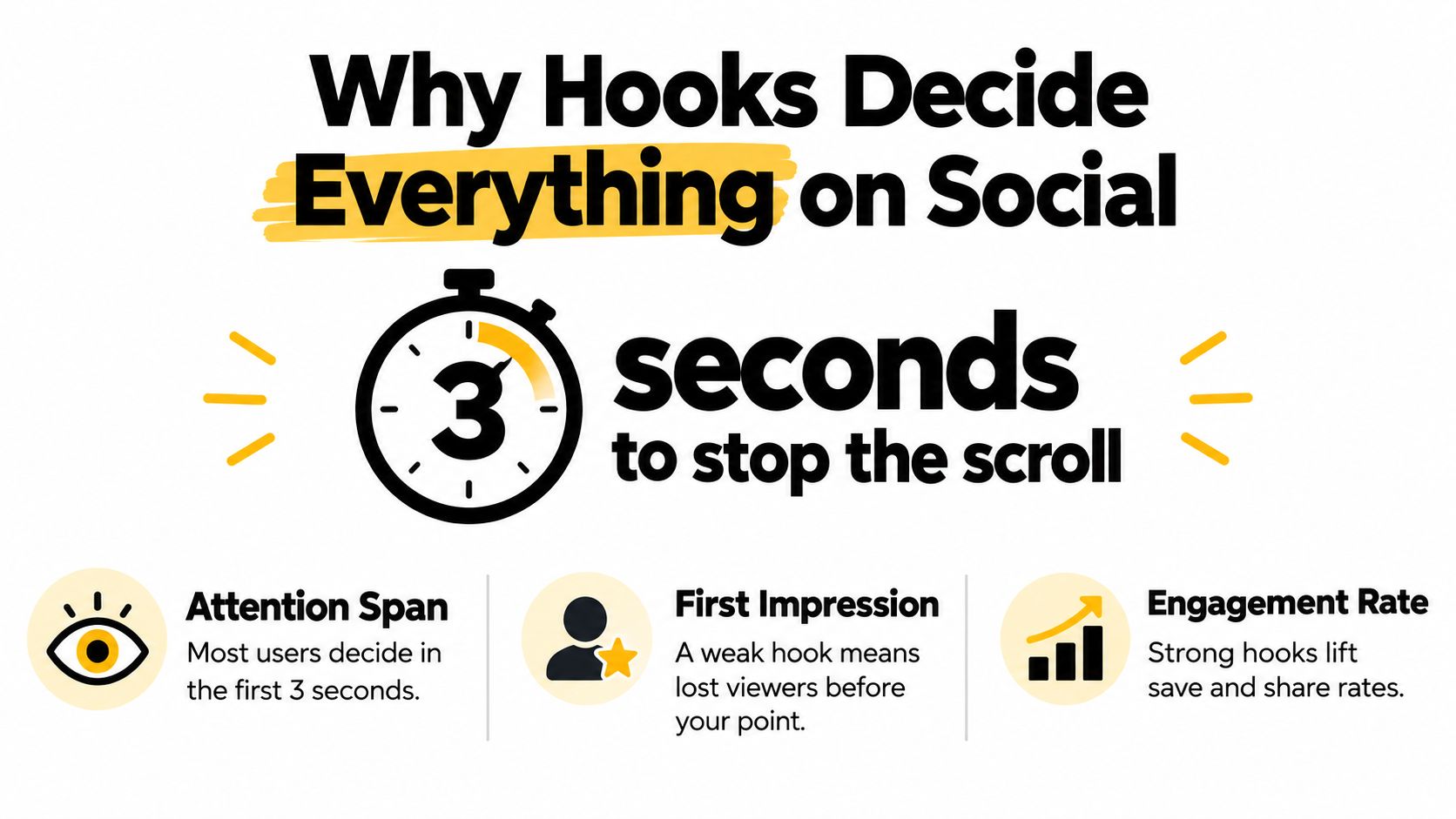
Why Hooks Decide Everything on Social
A social post competes inside a remarkably small decision window. Recent summaries of attention research estimate that the average social media post receives about 8 seconds of focus, down from roughly 12 seconds in 2000 and about 12.1 seconds in 2015, a decline of around one-third over the last decade, as reported in compiled social media attention-span research. Gen Z attention on a post is often estimated at about 6.5 seconds in the same summaries.
That doesn't mean every reader counts seconds. It means your first line, first frame, or opening sentence has to earn the next moment before the audience understands your full argument. A weak introduction can bury strong evidence, a useful framework, or a compelling product demonstration before anyone reaches it.
Practical rule: Treat the hook as the first retention test, not as decoration added after the post is written.
The broader usage environment makes this pressure harder. Global users reportedly spend about 144 minutes per day on social media, while TikTok users are reported to spend about 69 minutes daily on the app, according to industry attention-span reporting. That time is spread across an endless stream of competing posts, videos, comments, and recommendations.
The retention logic behind the opener
Platforms observe early behavior. Depending on the format, that can include three-second views, early watch time, read-more clicks, and whether viewers continue through the content. These signals help determine whether a post deserves more distribution, so a poor opener can cap reach even when the body copy delivers real value.
This is why I don't ask only, “Is this hook clever?” I ask four operational questions:
- Inputs: Is the angle specific enough to guide the generator?
- Formulas: Does the structure create a relevant reason to continue?
- Generation: Did I produce enough distinct options rather than polishing one weak line?
- Testing: Did audience behavior tell me what to change next?
A useful overview of the term and its role in marketing is Grou's B2B hook guide, especially if you're applying hooks to professional content rather than entertainment-led posts.
The Four Inputs That Make a Hook Generator Useful
A generator can only be as useful as the brief you give it. Enter “write a hook about productivity” and you'll usually receive safe lines that could belong to almost any creator. Add a defined tension, audience, voice, and platform, and the output has something concrete to work with.
Start with the four fields
Angle identifies the promise or conflict. “Productivity tips” is a topic. “Why productivity systems fail burned-out remote workers on weekends” is an angle with tension.
Tone controls how the idea sounds. “Professional” leaves room for bland corporate language. “Calm, candid, and slightly skeptical of hustle culture” gives the generator a recognizable voice.
Audience tells the tool what the reader already believes, fears, or wants. “Marketers” is broad. “Solo SaaS founders who publish consistently but attract few qualified demos” gives the hook a situation to address.
Platform determines the opening mechanics. A line for X can lead with a compact opinion. A LinkedIn hook may need a professional consequence. A TikTok opener has to work when spoken aloud and paired with a visual.
| Input | Weak Example | Strong Example | Why It Works |
|---|---|---|---|
| Angle | Write about productivity | Explain why weekend productivity plans fail burned-out remote workers | Creates a defined tension and promise |
| Tone | Make it engaging | Candid, practical, skeptical of hustle language | Gives the output a voice instead of generic enthusiasm |
| Audience | People who want better content | B2B SaaS founders struggling to turn expertise into qualified conversations | Names the reader and their commercial problem |
| Platform | Social media | LinkedIn text post with a professional, conversational opening | Aligns wording and pacing with the publishing context |
The difference is not cosmetic. A strong input tells the generator what to emphasize and what to avoid. For example, a direct question aimed at burned-out remote workers might become, “Why are your weekends full of productivity plans but empty of recovery?” The same topic aimed at SaaS founders could become, “Your content calendar isn't the reason your pipeline is quiet.”
Build prompts from real audience language
Use phrases your audience uses in sales calls, comments, support tickets, and community discussions. “I'm tired of posting into a void” gives a generator more usable material than “increase engagement.”
Also specify what the hook must not do. Ban empty claims, inflated promises, clichés, and unexplained jargon. These four fields, plus those constraints, form the foundation of the prompt workflow later in the article.
Seven Hook Formulas That Actually Convert
Formulas help because they reduce the blank-page problem. They don't guarantee performance, and they shouldn't replace judgment. A bold line aimed at the wrong audience still fails, while a simple question can work when it names a costly and familiar problem.
1. The bold claim
This structure makes a confident statement that invites the reader to verify it.
- Weak: “Content marketing is important for SaaS.”
- Strong: “Most SaaS teams don't have a content problem. They have a proof problem.”
The stronger version creates a clear disagreement and promises an explanation. It uses identity and debate, particularly for professional audiences that recognize the category but may question the diagnosis.
2. The contrarian take
A contrarian hook challenges accepted advice, but it needs a defensible point behind it.
- Weak: “You should rethink your marketing strategy.”
- Strong: “Posting more often won't fix a B2B content strategy that says nothing specific.”
This triggers curiosity because the reader expects the standard recommendation to be challenged. It flops when the reversal is merely provocative and the post later delivers generic advice.
3. The specific number
Specific numbers create boundaries and make a promise easier to understand. Use only numbers you can support in the post.
- Weak: “Here are some ways to improve onboarding.”
- Strong: “Three onboarding messages create most of the confusion in a new SaaS account.”
The number gives the reader a manageable scope. It can also signal clarity and structure, but fabricated precision damages trust, so don't add a number just to make a line look sharper.
4. The direct question
Questions invite the audience to compare the post with their own experience.
- Weak: “Want to grow your personal brand?”
- Strong: “What would change if your next post had to prove one opinion instead of summarize five tips?”
The first question is easy to ignore because nearly everyone wants growth. The second asks for a decision and creates a more specific curiosity gap.
5. The story tease
A story tease opens with a moment, mistake, or unexpected outcome without explaining everything immediately.
- Weak: “I learned a lot from launching my product.”
- Strong: “The demo went well until the prospect asked one question our landing page couldn't answer.”
This works through narrative tension. Readers continue because they want to know the question, the mistake, and the consequence. The story still has to pay off. Suspense without a useful lesson becomes clickbait.
6. The mistake warning
This formula frames the post as protection from a recognizable error.
- Weak: “Avoid mistakes in your LinkedIn strategy.”
- Strong: “If every LinkedIn post starts with your company announcement, you're making the reader work too hard.”
The trigger is loss aversion. The reader wants to avoid wasting effort or losing attention, especially when the mistake is concrete enough to recognize.
7. The pattern interrupt
A pattern interrupt breaks the expected rhythm with an unusual contrast, visual, or sentence structure.
- Weak: “Here are five tips for better product marketing.”
- Strong: “Stop adding features to your homepage. Start removing reasons to hesitate.”
The structure creates a momentary pause by reversing the familiar recommendation. On video, the interruption might be a surprising first frame or an immediate demonstration. The line must remain relevant, or the interruption feels like a trick.
Use these formulas as scaffolding. Tell the generator which one to apply, then request alternatives that preserve the same audience problem and promise. A formula bank is useful only when the inputs keep the output grounded.
Generating Hooks With a Prompt-Driven Workflow
A good prompt turns a generator from a random-idea machine into a controlled drafting partner. Start with the four fields already defined, then add format, exclusions, and evaluation criteria.
Use a single prompt block like this:
Create 10 hooks for a [platform] post.
Angle: [specific promise, tension, or opinion].
Audience: [specific person and current problem].
Tone: [voice, energy, and point of view].
Format: [text post, video opening, carousel cover, or caption].
Formula: [bold claim, contrarian take, question, story tease, or another formula].
Constraints: keep each option within the platform's visible opening, avoid clichés and unsupported promises, and make the first phrase distinct.
Output: list the hooks, label the formula used, and add one sentence explaining the intended reader reaction.
The prompt should produce variation, not ten versions of the same sentence. If the results are flat, refine the input before blaming the tool.
Three useful refinement passes
Weak prompt: “Write hooks about customer retention.”
Tighter prompt: “Write hooks for product-led SaaS founders whose trial users activate but don't return. Use a candid, diagnostic tone and focus on the gap between activation and habit.”
Weak output: “Improve customer retention with these helpful tips.”
Refined request: “Rewrite this as a specific diagnosis. Name the behavior that causes users to leave, but don't reveal the fix.”
Weak output: “Learn how to improve your SaaS onboarding.”
Refined request: “Turn this into a curiosity-driven opening for a LinkedIn text post. Contrast what teams measure with what users experience.”
The first pass adds audience reality. The second adds specificity. The third controls what information the hook withholds, which helps create intrigue without making an unsupported promise.
For broader production work, ShortGenius AI ad generator can be useful when you need to move from an opening idea toward video or advertising creative. Keep the hook brief, then ask for the supporting script separately so the opening doesn't become overloaded.
You can also use this social media post generator workflow to structure the rest of the post after selecting the hook. The opening and body should support the same promise, not compete with each other.
Before publishing, perform two human edits. Remove any phrase you wouldn't say aloud to the intended audience, and check that the body delivers the exact expectation created by the first line.
Adapting Hooks for Each Platform
The same idea shouldn't be copied across every channel. Each platform gives the opening a different job, and the surrounding format changes how quickly the audience can understand it.
Take this underlying idea: your SaaS onboarding contains too much information too early.
| Platform | Ideal Hook Length | Tone | Opener Style |
|---|---|---|---|
| X | Short and compact | Opinionated | Contrarian statement or sharp contrast |
| Brief opening followed by context | Professional and candid | Business consequence or diagnosis | |
| Short visible caption or text overlay | Visual and conversational | Bold phrase paired with a clear image | |
| TikTok | Spoken opening with immediate visual support | Direct and energetic | Audio-friendly question, claim, or demonstration |
| Direct first sentence, followed by detail | Helpful and community-aware | Value-first observation or practical answer |
One idea, five rewrites
X: “Your SaaS onboarding isn't too short. It's trying to explain everything before users do anything.”
LinkedIn: “Most SaaS onboarding teams optimize for information coverage. Users often need one clear next action instead.”
Instagram: “Too much onboarding, too soon. Show one next step, not the whole product.”
TikTok: “Your users aren't confused because the product is complex. They're confused because your onboarding starts with five decisions.”
Reddit: “If trial users keep asking what to do next, remove the first layer of choices and give them one meaningful action.”
The X version takes a position quickly. LinkedIn connects the issue to a professional practice. Instagram depends on visual reinforcement, so the text should work as an overlay or the first visible caption line. TikTok needs language that sounds natural when spoken and should pair the claim with a screen recording, gesture, or product moment. Reddit generally rewards immediate usefulness over theatrical suspense.
Check the fold and the first frame
On text platforms, write the hook before the truncation point and make the next line support it. On video platforms, put the core promise in the spoken opening and on-screen text, but don't make the two versions compete.
If you're turning the same idea into a spoken script, this TikTok script generator resource can help translate the angle into a more natural sequence. Still review every script aloud. A line that looks punchy on screen can sound stiff in speech.
Testing Hooks and Feeding the Data Back
A hook generator gives you candidates. Publishing gives you evidence. The useful question isn't whether a line sounds clever in a document. It's whether the right audience continues, finishes, saves, and responds with meaningful intent.
Use four signals:
- Three-second hook retention: Where the platform provides it, check whether viewers remain beyond the opening.
- Completion rate: See whether the audience reaches the end of the video, carousel, or written sequence.
- Saves: Treat saves as evidence that the content feels useful enough to revisit.
- Comment quality: Separate relevant questions, objections, and experience-sharing from empty reactions.
Industry guidance commonly treats the first 1 to 3 seconds as the critical capture window, with some benchmarks describing Instagram and TikTok attention capture at roughly 1.3 to 3 seconds, as discussed in independent hook guidance. Use that evidence to prioritize the opening, but compare results within the same platform, format, audience, and objective.
Score patterns, not isolated vanity signals
Create a simple internal scorecard. You can mark each metric as strong, mixed, or weak relative to your own recent posts. Don't declare a winner because it received more comments if those comments show confusion or disagreement unrelated to the intended topic.
For example:
- Hook A: Strong early retention, strong completion, mixed saves, high-quality questions.
- Hook B: Weak early retention, moderate completion among remaining viewers, few saves, short reactions.
The diagnosis points toward Hook B's opening rather than its full argument. It may have used the wrong angle, sounded too broad, or failed to make the audience's problem visible quickly enough.
Measure the first failure point. If viewers leave immediately, rewrite the opening before changing the entire post.
After each batch, feed the result back into the next prompt. A useful refinement might say: “Generate new LinkedIn hooks for the same audience. Keep the practical onboarding angle, remove broad productivity language, use a direct business consequence, and produce alternatives based on the stronger retention pattern from the previous batch.”
That creates a learning loop:
Generate, publish, inspect, diagnose, revise.
The underanswered question in most generator advice is whether a hook works for a particular market and objective. Hook-generator guidance from Kadenzo is useful as a reminder to focus on niche fit and learning, not just template collection. Your own audience data should decide which patterns remain in the prompt library.
Your Repeatable Hook Writing Workflow
Turn every writing session into a checklist:
- Define the angle, audience, and platform before opening a generator.
- Draft 10 options using one formula or a controlled prompt.
- Cut any opener that doesn't fit the platform's visible first line or first frame.
- Test the strongest three by changing the opener while keeping the core content consistent.
- Pull early retention and comment-quality data after the post has had time to gather meaningful responses.
- Log the winner in a swipe file tagged by formula, audience, and platform.
Keep the actual post attached to each winning hook. A line that works for a founder's LinkedIn diagnosis may fail as a TikTok voiceover, even when the underlying idea is sound.
For a complementary view on writing persuasive openings for paid campaigns, review these paid social ad copy tactics. Then organize the testing notes, prompts, and winning variants in a repeatable social media content workflow.
After several cycles, your generator inputs become more specific because they reflect what your audience stopped for. The tool doesn't magically develop your brand voice. Your testing log teaches you which angles, formulas, and constraints sound like your brand.
Prompt Builder helps marketers generate, refine, test, and organize model-tuned prompts for social content, including platform-specific hooks for X, LinkedIn, Instagram, TikTok, and Reddit. Visit Prompt Builder to turn your strongest hook patterns into reusable prompts, then build the next batch from evidence instead of starting with a blank page.
Related Posts
6 Quick Prompts Every Food Influencer Should Try
October 1, 2025
10 TikTok Content Ideas for Marketers and Creators
September 2, 2026
1000 Writing Prompts: The Definitive AI Guide 2026
July 15, 2026