
Product Description Writing That Converts in 2026
You've got a product page that looks finished. The images are sharp, the price is live, and the buy button works. Yet the description still says “premium quality,” repeats the manufacturer's feature list, and leaves shoppers wondering whether the product fits their actual situation. That gap is where add-to-cart decisions stall.
Product description writing works best when you treat it as merchandising, not decoration. The copy should reflect the language buyers use in reviews, searches, support questions, and comparisons, then turn that evidence into a page that answers objections in the right order. AI can accelerate the drafting, but only after you give it useful research and strict constraints.
Table of Contents
- What Product Description Writing Does for Sales
- Research Buyers Before You Write a Single Word
- A Reusable Structure for Any Product Page
- Length, Tone, and Format by Product Type
- On-Page SEO for Product Descriptions
- AI Prompts That Produce Usable Drafts
- Common Mistakes That Quietly Kill Conversion
What Product Description Writing Does for Sales
A shopper can reach a product page ready to buy and still hesitate because the description leaves one practical question unanswered. Effective copy explains what the item does, why it fits a specific use case, and what evidence supports the choice. It also gives search engines language beyond the product name, helping them match the page with the terms buyers use.
Description quality is therefore a measurable merchandising variable. Industry research summarized by research summary on product descriptions and conversion reports that 87% of consumers rate product content as extremely important when deciding whether to buy, while 20% of purchase failures stem from incomplete product information. The practical priority is clear: resolve decision friction before polishing brand language.
The four-part operating framework
Use buyer research as the input. Gather phrases from reviews, site searches, support tickets, and competitor comparisons. That language exposes concerns an internal team may miss and gives AI prompts grounded material for drafting rather than generic instructions.
Build the page in this sequence:
- Identify intent and objections. Define the desired outcome, likely doubts, and vocabulary shoppers already recognize.
- Lead with the outcome. Open with the buyer-visible result, not the material, mechanism, or SKU name.
- Connect benefits to proof. Use bullets and supporting details to show how the product produces that result.
- Place specifications lower. Keep dimensions, compatibility, care, and technical information accessible without asking them to carry the opening.
This workflow aligns with conversion-focused product description workflow, which places intent and objections first, then moves from the primary outcome to benefit-linked bullets and detailed specifications.
Measure the page as a sales asset
Word count is a weak success signal. Track add-to-cart rate, bounce rate, return rate, scroll depth, and revenue per visitor, then compare results with the product's traffic source, price, and purchase cycle. A longer description may help a technical product while slowing evaluation for a simple, familiar item.
Use controlled page tests when traffic allows them. Change one meaningful element at a time, such as the opening benefit, objection handling, or specification placement, and judge the result against commercial outcomes rather than clicks alone.
For a platform-specific reference, product description writing for Shopify shows how to adapt this structure to a Shopify product page. The operational shift matters: the description is part of the sales presentation, not a final checkbox after photography and pricing.
Research Buyers Before You Write a Single Word
The most reliable description rarely begins with a blank document. It begins with evidence from people who have already considered, bought, used, disliked, returned, or compared the product.
Start with one- and two-star reviews on your own product and comparable competitor pages. Positive reviews tell you what customers value, but negative reviews reveal the objections your description must address. Sort the comments into themes such as fit, durability, setup, compatibility, cleaning, delivery expectations, or performance in a specific use case.
Build a buyer-language bank
Don't replace customer wording with polished catalog language too early. Preserve the phrases that make the concern recognizable. A shopper who writes “does it work with a thick phone case?” has given you a sharper copy brief than a generic instruction to “mention compatibility.”
Mine additional sources:
- Site search logs: Record searches that return weak or irrelevant results. They often reveal missing attributes and use-case language.
- Chatbot transcripts: Pull repeated pre-purchase questions, especially questions that appear immediately before product selection.
- Support tickets: Separate product confusion from post-purchase issues. The first group belongs on the page; the second may indicate a clarity or expectation problem.
- Competitor reviews: Look for recurring complaints that your product solves. Don't claim superiority unless your evidence supports it.
- Autocomplete and People Also Ask: Compare search phrasing with customer phrasing. This helps you connect natural language to discoverable query variants.
A study on the semantic gap between user-generated content and product descriptions found that reviews and descriptions differ materially in language and emphasis (research on the semantic gap between reviews and product descriptions). The implication is important: a stronger page may not need more adjectives or more paragraphs. It may need the words buyers use when weighing trade-offs.
Where to source buyer language
| Source | What to Extract | Time Cost |
|---|---|---|
| Your product reviews | Repeated benefits, complaints, use contexts, and expectation gaps | Low |
| Competitor reviews | Unmet needs, switching reasons, and category objections | Medium |
| Site search | Attribute terms, compatibility questions, and missing content | Low |
| Chat and support | Exact pre-purchase questions and confusing specifications | Medium |
| Search suggestions | Natural query variations and comparison language | Low |
| Community discussions | Informal vocabulary and real-world usage situations | Medium |
Feed this research to your drafting workflow as a structured input. The description should sound like a knowledgeable version of the customer conversation, not a rewrite of an internal product sheet.
A Reusable Structure for Any Product Page
Most product pages lose force because the writer improvises the order. A reliable structure gives each piece of information a job and lets shoppers scan without missing the central promise.
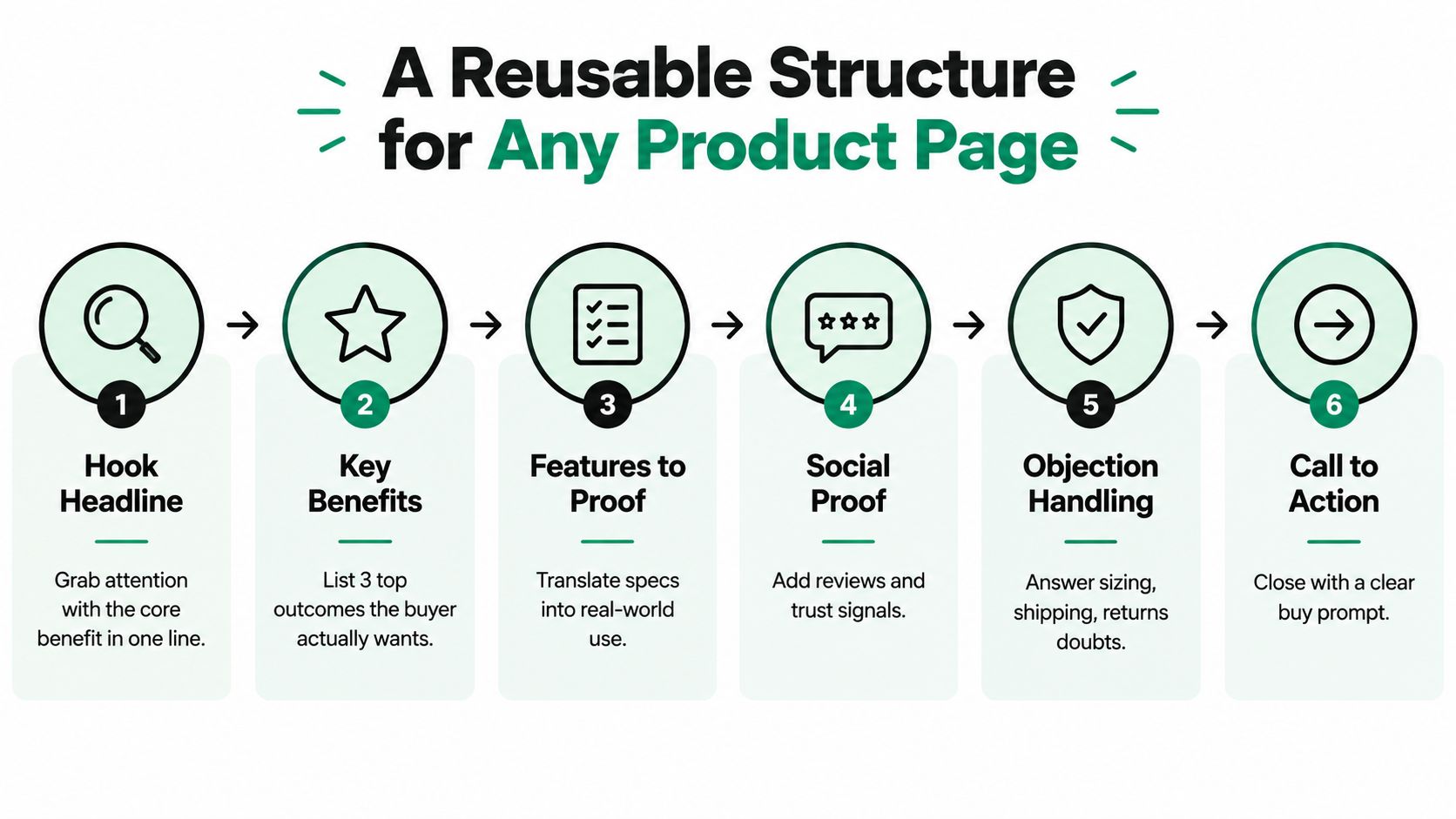
Start with the buyer's desired outcome
The opening hook should identify the intended shopper and the result they want. “A gooseneck kettle for more controlled pour-over brewing” gives the reader a reason to continue. “A stainless-steel kettle with a narrow spout” merely names construction.
Follow with a short paragraph that positions the product as the means to that outcome. Keep the explanation concrete. State what the shopper can do, experience, or avoid.
Translate features into visible benefits
Use four to six benefit bullets when the product has several meaningful decision factors. Lead each bullet with the gain, then support it with the feature that makes the gain credible.
For a $79 pour-over kettle, the sequence might look like this:
- Pour with more control: The gooseneck spout supports a steadier flow for deliberate brewing.
- Repeat your process: A clearly defined flow behavior helps home brewers follow the same pouring routine.
- Keep the brew temperature steadier: Heat-retention details support a more consistent brewing session.
- Fit the morning setup: The format suits a home brewer who wants café-style control without a commercial station.
Don't turn every technical detail into a benefit. Some specifications exist to answer compatibility or safety questions, and they belong in the specs block.
Add proof, then resolve practical doubt
Place a short proof block after the benefits. Use an actual review excerpt, verified testing detail, or credible product evidence. Don't manufacture certainty from an unsupported superlative.
Close with specifications, sizing, compatibility, care, and any other information that affects purchase confidence. The CTA should mirror the desired outcome, such as “Brew a more even cup tomorrow.” A $15 accessory may need only a hook, a few benefits, and compatibility notes. A $1,500 appliance can expand the proof and technical sections without changing the basic order.
Length, Tone, and Format by Product Type
There isn't a universal word count for product descriptions. Length should follow price, decision risk, and category expectations.
A low-cost accessory usually needs quick reassurance. Buyers want to know what it works with, what arrives in the package, and whether it solves the immediate problem. A considered purchase deserves more explanation because shoppers compare performance, maintenance, fit, and long-term usefulness.
| Product Tier | Word Count | Tone | Best Format |
|---|---|---|---|
| Low-cost add-on | Brief | Direct, energetic, confident | Short paragraph and focused bullets |
| Everyday considered item | Moderate | Helpful and specific | Outcome-led copy, bullets, and compact specs |
| Premium or technical product | Extended | Measured, expert, reassuring | Benefit sections, proof, comparison details, and expandable specs |
| High-risk fit or compatibility item | As long as needed | Precise and objection-aware | Fit guidance, compatibility table, FAQs, and clear limitations |
Consider the same product at two decision levels. A basic cable description can say, “Keep your phone powered at your desk or in the car with a durable cable built for everyday charging. Check the connector and device compatibility below before ordering.” That is enough if the main risk is choosing the wrong connector.
A premium charging station needs a different treatment. The page should explain the intended setup, charging behavior, materials, device compatibility, placement, and limitations. More detail earns its space only when it reduces uncertainty.
Format for scanning, not decoration
Bullets work when each one answers a distinct buying question. Paragraphs work when the reader needs context or a short explanation of use. Comparison tables earn their space when shoppers are choosing among variants, but they become clutter when every minor specification receives a row.
A 2,000-word essay for a low-cost add-on usually creates friction. Conversely, a thin paragraph for an expensive or technically complex item forces shoppers to search elsewhere, where competitors can answer the question first.
On-Page SEO for Product Descriptions
Product-page SEO should support the buying conversation rather than interrupt it. Put the primary phrase in the product title, the page's main heading, the opening sentence, and the meta description when it fits naturally. Don't repeat it mechanically.
Use semantic variations to describe the same product in the language shoppers use. Include use-case phrases, material terms, compatibility details, sizes, finishes, and problem-oriented wording in bullets and subheadings. A page for a pour-over kettle might naturally include controlled pouring, gooseneck spout, home brewing, temperature retention, and coffee preparation, provided those terms accurately describe the item.
Support the main copy
The surrounding page elements help search engines and shoppers interpret the product:
- Title and meta description: State the product and its most relevant outcome without turning the snippet into a keyword list.
- Image alt text: Describe the product and its meaningful visual context in plain language. Don't use alt text as a hidden keyword field.
- Product structured data: Mark up accurate product, offer, review, and FAQ information where the page contains it.
- Internal links: Link from relevant category and collection pages using descriptive context, so the product sits clearly within the catalog.
- Variant information: Keep size, color, compatibility, and availability details consistent across visible copy and structured data.
SEO shouldn't force an awkward sentence such as “Buy best pour-over kettle pour-over kettle for pour-over coffee.” That phrasing may contain the term, but it damages recognition and trust. For prompt-supported SEO workflows, this guide to using AI for SEO can help teams turn keyword and page requirements into clearer drafting instructions.
The strongest product page satisfies both systems. Search engines can identify the item and its context, while shoppers can understand the product without noticing the optimization.
AI Prompts That Produce Usable Drafts
Most AI product descriptions fail before generation begins. The prompt asks for “a compelling description,” provides little product evidence, and then treats fluent output as finished copy. A better workflow treats AI as a structured drafter that needs customer language, verified facts, format constraints, and a defined buyer.
Pattern one for a full structured draft
Use this with ChatGPT, Claude, Gemini, or another model that handles structured instructions well.
Prompt
Draft a product page for [PRODUCT] aimed at [BUYER]. Use this structure: hook, outcome paragraph, benefit bullets, proof block, objection handling, specifications, and CTA. Use only these verified facts: [FACTS]. Incorporate these buyer phrases naturally: [REVIEW AND SEARCH PHRASES]. Address these objections: [OBJECTIONS]. Tone: [TONE]. Length: [LENGTH RANGE]. Do not invent test results, materials, compatibility, reviews, or guarantees. Flag missing information instead of guessing.
Inputs to plug in: buyer profile, product facts, review snippets, target phrase, objections, price tier, and voice notes.
Best fit: General-purpose models and long-context models.
Publishable output example after light editing: “Control your morning pour with a gooseneck kettle made for repeatable home brewing. The narrow spout supports a steadier flow, while the heat-retention design helps you follow a consistent routine.”
Before publishing, compare every factual sentence against the product record.
Pattern two for turning reviews into benefits
This prompt is useful when your raw material is rich but unorganized.
Group these customer review excerpts into recurring needs, benefits, objections, and use contexts. Preserve the customers' wording where it clarifies intent. Then write five benefit bullets. Each bullet must lead with a buyer-visible outcome, support it with a verified product detail, and avoid claims not present in the inputs. Label any unsupported idea as “needs verification.” Reviews: [PASTE EXCERPTS]. Product facts: [PASTE FACTS].
Best fit: Models with strong summarization and classification abilities.
Example output: “Set up without guesswork: The included compatibility guide helps shoppers confirm fit before ordering.” Publish that only if the guide exists.
Pattern three for improving weak copy
Audit this product description against the following criteria: outcome-led opening, buyer-language alignment, benefit-to-feature connection, objection coverage, scannability, factual accuracy, SEO naturalness, and CTA clarity. List the weaknesses first. Then rewrite the description using the same verified facts, preserving any accurate information and marking missing evidence. Original copy: [PASTE COPY]. Buyer evidence: [PASTE RESEARCH]. Brand voice: [PASTE NOTES].
Best fit: Models used for editing and critique, especially when you need controlled revisions.
For teams building reusable prompt workflows, this product description generator resource can provide a starting point for structuring inputs and outputs. The model should produce a draft, not permission to skip review.
Common Mistakes That Quietly Kill Conversion
A product page can look polished and still leave shoppers without a clear reason to buy. The warning signs usually appear in the gap between what the copy says and what the buyer needs to decide. These are the failures I check first when a product page attracts traffic but struggles to generate add-to-cart actions.
Seven copy problems worth fixing
-
Leading with features instead of outcomes. “Made with double-wall stainless steel” asks the shopper to interpret the benefit. Start with the result, then connect it to the construction: the insulated design helps maintain temperature and may improve handling. Publish only the performance claim the product record supports.
-
Repeating the SKU name as a noun. “The Kettle KX200 gives KX200 users…” sounds like catalog automation. Use natural references such as “the kettle,” “this model,” or a specific use case. The product name still belongs in the title and relevant headings, where it supports recognition and search.
-
Ignoring the strongest objection. Reviews and support tickets often reveal the question that stops the purchase: Does it fit? How is it cleaned? What does it work with? Put the answer near the feature or benefit that creates the concern. A short review sweep can expose a missing detail that polished brand copy never addresses.
-
Packing specifications into unreadable bullets. A bullet containing dimensions, materials, warranty terms, voltage, care instructions, and shipping information forces shoppers to sort several decisions at once. Keep the primary bullet stack focused on benefits and buying criteria. Move dense technical details into a labeled specifications block or accordion.
-
Using a generic brand voice. Luxury skincare, replacement parts, technical tools, and children's products earn trust through different cues. Match the category's expectations first, then add brand personality without hiding practical information. A distinctive voice cannot compensate for unclear fit, use, or care instructions.
-
Applying inconsistent depth across a catalog. Comparable products should meet the same minimum content standard, including the primary outcome, key specifications, common objections, proof, and a clear next action. Add more explanation to products with higher price, technical complexity, compatibility risk, or return risk.
-
Skipping the final CTA. The page button is only one point of guidance. Add a short line above it that restates the buying outcome, such as “Choose the right size for a more secure fit.” The line should support the decision, not repeat “Buy now” in different words.
Turn revisions into a controlled process
Copy changes become easier to judge when each one has a defined job. Select one product, one primary metric, and one hypothesis. For example, test whether moving compatibility information above the specifications block improves add-to-cart rate. Keep the hypothesis narrow enough that the result can guide the next revision.
Set the test period and decision rule before launch. Compare reasonably similar traffic conditions, record promotional changes, and avoid treating an early result as a final answer. Low-traffic products and promotion-heavy periods can make a weak version appear stronger than it is. Use secondary signals, such as interaction with the specifications area or scroll depth, to understand shopper behavior, while keeping one primary metric for the decision.
Record the product, hypothesis, copy versions, launch dates, traffic conditions, primary metric, secondary signals, and merchandising changes. This log prevents teams from arguing from memory and makes useful patterns easier to find across products. A practical conversion rate optimization process for product pages can help formalize that habit.
A launch-day audit
Use this checklist before publishing:
- Buyer evidence: Can you identify the reviews, searches, or support questions behind the wording?
- Structure: Does the page move from outcome to benefits, proof, objections, specifications, and CTA?
- Accuracy: Can every factual claim be verified against the product record?
- Search alignment: Does the primary phrase appear naturally in the title, heading, opening, and metadata?
- Scanning: Can a mobile shopper understand the main value from the opening and bullets?
- AI control: Did the prompt include verified facts, buyer language, tone, and forbidden assumptions?
- Measurement: Is one primary metric defined before the copy goes live?
Product description writing should produce an auditable merchandising asset. Research the language buyers already use, map that language to verified product facts, publish a structured page, and measure the decision behavior it supports. Treat AI as part of that workflow, from review classification through draft critique, rather than as a final shortcut.
Prompt Builder helps teams turn buyer research, verified product facts, and page structure into model-specific prompts they can refine and reuse. Visit Prompt Builder to build controlled product-description workflows, compare prompt variations, and maintain the versions your team approves.
Related Posts
Prompt Automation Explained How to Scale AI Workflows
September 16, 2026
Call to Action Generator: How to Write CTAs That Convert
September 14, 2026
10 Newsletter Content Ideas That Keep Readers Engaged
September 8, 2026